Showing posts with label terrorism. Show all posts

Thursday, 25 April 2013

The Independent (Work Experience): Growing Up With Iraq.

This article was written for The Independent and published on their website 20th March 2013:
http://www.independent.co.uk/voices/comment/growing-up-with-iraq-8542599.html

AT the close of the Iraq War, Tony Blair visited troops on active service and declared that the supposed triumph in the Middle East was a momentous part of our generation’s history. “When people look back on this time, and look back on this conflict, I honestly believe that they will see this as one of the finer moments of our century” he said with confidence. Riding high on the wave of a euphoric sense of victory, the Prime Minister believed that he had proved doubters of the Iraq War wrong: his deliberately obstinate stance in the face of record protesters in the months preceding the war had apparently paid off. But not all victories should be measured by the physical change.

A decade after the conflict began, we are still living with its legacy, and feel the force of threat even more every day. A younger generation are now becoming part of the electorate; a generation for whom the Iraq War was their first engagement with pressing and current world issues. For those in their late teens and early 20s, this is their first memory of war.

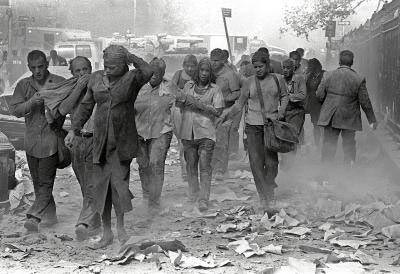
Far from the prescribed school curriculum of World War II and the great British and Allied victories of the twentieth century, here was a confusing and confounding picture of modern warfare. Two of my clearest childhood memories revolve around the ‘war on terror’: the attacks of 9/11, and the opening bombardment on Baghdad some ten years ago. The former event I did not fully appreciate at the time, but remember my mother frantically trying to find a channel with children’s shows to distract our attention whilst she watched upstairs. The later seemed a rite of passage: I watched the images aged just ten, with my parents alongside.

Barrage

The picture was bewildering. How were we the good guys if we were launching such a massive barrage of destruction on this weaker nation? As a child in primary school, it was too much to comprehend.

Intervening years of destruction, violence and chaos followed, and I found myself questioning Blair’s resounding sentiment of success. Did we feel any safer in this modern world? Alongside dwindling support for the Iraq War grew increasing resentment and discontent. I came to the belief that this had been an exercise in vanity and massaging the egos of world superpowers.

As a country, we have never felt less safe as a result of British action abroad. A recent YouGov poll, carried out to coincide with the ten year anniversary of the Iraq invasion, reveals that a majority (56 per cent) of the public share this believe that the war has increased the risk of a terrorist attack on the UK, while less than a tenth of participants (7 per cent) believed it had decreased the risk of attack. It is a similar story in the US, where almost half (48 per cent) of people believe the conflict has not contributed to the long term security of the country.

In his ‘Discouraging Citizenship?’ paper, Stephen Cushion identified that “the 10–14 year old age group were the most anti-war (62 per cent opposing it), followed by the 19–22 group (47 per cent).” back in 2003. The massive 62 per cent against war are now feeling the impact of an oblivious government in which they had no say.

Apathy

When an estimated two million people marched on Westminster in 2003, placards of the mass anti-war demonstration read “Not in My Name”. The current distrust of young adults is easy to explain. This war we knew little about was waged in our name, and now we are the generation that have to deal with the consequences in a supposedly more threatening world.

Disengagement with politics does not stem from youth apathy as many assume, it sprouts from this cultural moment of war, a major milestone in public consciousness and disillusionment with the political monopoly. As the first people to grow up absorbing information from the TV, internet websites and social media, our fears and feelings, our misconceptions and misunderstandings of war are reinforced through every medium. For all the supposed benefits, we still feel less and less safe.

In his inauguration speech for his second term of office at the White House, Barack Obama announced that “a decade of war is now ending.” Withdrawing troops is not the end of the war however. While Western democracies may believe they have won a battle, the war on terror continues for those who are forced to live in the aftermath. Even if you are too young to remember the demonstrations in London, or the initial invasion, the cynicism is likely to have seeped in from reports of terrorist threats, 7/7 and elder siblings. Far from the glory of Tony Blair’s victory speech, this war will perhaps now be remembered as the finest example of the century’s incompetence and its legacy now overshadows the young. 

Sunday, 11 September 2011

In The Wake of 9/11


A spectre is haunting the world. A spectre that hangs on a global scale.

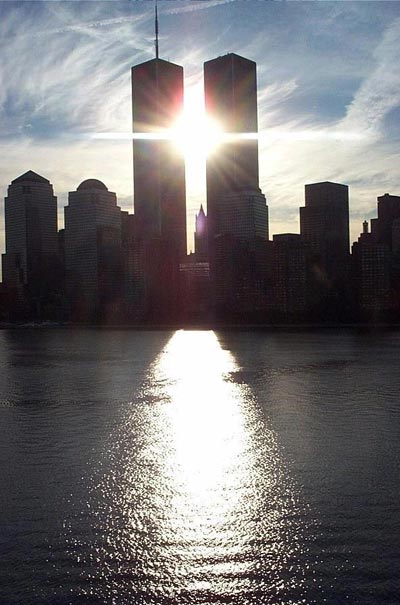
Just one decade ago, as the shadow of one structure fell from the Manhattan skyline, another erect itself in its place. Greyer than its predecessor, this new structure threw a dark hue over New York, America and the world.

Over the course of an intermittent ten years, the word terrorism has come to take a prevalent place in the life of many in the Western World. Those who are now coping with the legacy of 9/11, the so called 9/11 generation, live in a domain where attack comes in any form at any time, in order to strike fear into the civilised fronts of Europe, America and Asia.

Essentially, we live amidst the largest battle of ideologies since the Cold War.

Now, as in the period that saw a stalemate of superpowers, many people wonder whether today will be one that sees their daily life thrown into chaos. When once a battle was something that happened away from public view, not only is it now an inherent part of the media and our daily life, but it could impact personally. Whether friend, family member or threat to self, with attacks on trains in Spain, airports in Glasgow and tube systems in London, the shocking increase in the frequency, ingenuity and scale by which these terror threats manifest themselves means that peace is on hold.

Segregation is the first and most evident effect on society. Many Muslims in America recount the weeks and months and even years following the devastating attacks on the country that essentially left them without identity. Belonging to a community that took credit for the death of almost 3,000 people, these American citizens became shunned.

Some claim that their livelihoods were threatened, others lost jobs and racial insensitivity ensued with the rise of misunderstanding and hatred.

One day has come to personify an entire religion and cross section of society, without room for their defence.

Recently in France, there has been a ban on the burka in public places and those with professional careers. The French government advocates that this move is to enable people of all faiths to come closer, eliminating a potentially boundary between social groups. Others remain indignant and see it as a source of racism. Elsewhere, as the clean-up from riot torn Britain continues, there are a select number who laid blame on social divisions between ethnic minorities. These fragments that have broken away from daily society trace routes to problems established on that September morning in 2001.

Although subsequent wars in Iraq and Afghanistan have played out on a different continent, the psychological effects reach further. For those who know any serving member of the army, each day is a blessing, as no news is good news. Establishing Middle East war zones sets up a dichotomy by which there is a comfort that there is justice for the innocent people that lost their lives, yet the dangers of antagonism, overthrowing illusive figures and daily bombings adds to death tolls.

More importantly on home fronts, with Wootton Bassett ending its tour of duty as representative for those fallen, an entire town is bearing responsibility for public grief one last time. Across the Atlantic, one prison has become so intertwined with the myth of Army brutality in the name of public safety that there is a passive acceptance to its morals.

These are the truths of life post 9/11. Initial reactions to a plane hitting the North Tower were the cries of a tragic accident. Barely 15 minutes later, all such nativity and good nature was lost not only from those who lived in New York, but gradually across America and later Europe.

News channels now do not hesitate to question whether some unidentified disruption is the cause of a terrorist attack. Until September 2001, there would have largely been questions that came before this: what was known of the problem, or what were the authorities doing, or whether there would be a state of normality resumed soon?

Now: Is it a terrorist attack? Who claimed responsibility? What could have been done?

For all the expectations of attacks that are now a constant worry of the average person, still each extravagant declaration of a problem with a nation comes as a surprise. What did we learn from 9/11? Extremists still managed to successfully detonate a bomb in Spain. English police forces had tips of an upcoming attack on Underground facilities and yet services remained unprepared in the event. 

Norway, the latest victim, disbands the belief that only countries of certain proficiency and status on a global front are targets. Although only the actions of one man, the ripples of this double attack are testament as to how far social divisions are at a play on a global scale.

The worry is that such divisions are irreconcilable and beliefs incompatible.

From the ashes of ground zero, the ashes of dead businessmen and women, should instead rise a beacon of hope and a dedication, a pledge, that never again should deaths of innocent people be the bi-products of hatred.

However, this can never be the case if there remains a volatile system that constantly refers to broken social groups and minorities as outsiders.

Following 9/11, the role of the media should be to focus on stories and occasions wherein there has been a coming together, a conglomeration, of different segments of society. We all bear a responsibility to accept, understand and recognise the rights of individuals and groups and their ways of life.

Instead, in film, in press and on radio, the reverberated sound is one of hatred and denial. Hollywood has cashed in on a priceless tragedy. Blockbuster releases, such as ‘World Trade Centre’ and ‘Flight 93’, do not aid the public memory of the attacks on America. Rather they are demeaning to American citizens, whose lives were cut short, doing their jobs. In the press, we seek to lay blame solely on those in the East and quickly forget the role the West has played in previous decades; supplying arms and choosing sides is but all forgotten amongst the chaos.

Somewhat with bad taste, the humorous ‘4 Lions’ mockuments the plans of 4 would be terrorists. Despite the comedy film, it is this ironic take on something so serious that has a relaxed stance taken by public officials. If we are able to laugh in the face of adverse terror, why should we prevent it?

Media outlets are the voice of the 9/11 generation. Their function should be to allow a communication between those victims of attacks, to ease their pains and to bring society together.

A spectre of terror haunts the modern world. Whilst it is a unifying spirit, it is simultaneously a spirit of terrible trepidation and divisive deeds. Since its inception, this ghost of fear has served to make one group a scapegoat and one group a leader of peace. It lingers to separate world populous into those who are would be victims of terror and those who incite terror.

Instability abound, the Western world finds itself precariously balanced: for with power comes a duty of care. If it is to lead nations from the threat of external invasion, it firsts need look within and proactively protect its citizens.

9/11 serves as an unheeded warning. Most remain unprepared for an attack and many remain ignorant of the country and customs of those being invaded. The media breaches its own duty in not being a reliable source of information.

No longer can terrorism be swept under the rug: it is public domain.  

Currently, the Manhattan skyline is dominated by the spectre that stands at 1,368 ft. Soon, it will be joined at that height by World Trade Centre 1, or Freedom Tower. With Freedom comes the hope that the current ideology of terror will be washed by the waters of the fountain that circle the Twin Tower base: otherwise, there will progress a stalemate of fear, a waiting game of attack and consequence. 


Countries where there have been attacks with more than 20 victims since 2001.

"During the 1990s, world leaders looked at the mounting threat of terrorism, looked up, looked away, and hoped the problem would go away."
-John Boehner

Monday, 1 August 2011

“Atrocious but necessary”.


A little more than a week ago, Norway became the latest country of the EU to suffer a terrorist attack. Whilst the world is used to outside agents or people working on behalf of foreign terror groups acting against a particular nation, these events stood out because their perpetrator was in fact a Norwegian as well. 

Anders Behring Breivik bombed the capital city Oslo on the 22nd July just hours before he started to gun down people at a youth holiday camp many miles away on Utoeya Island. The corresponding attacks across different regions of the country show a precise and vicious will; a will deemed by Breivik as “necessary” for his country’s future. 

As concerning as both the events and the lack of response appear to the outside world, the restrained grieving is much more common in Norway, and today, the country’s PM warned against a ‘witch-hunt’ following the crimes.

Justifying these horrors is indeed hard to accept, however the suspect has laid out his plans in a manifesto style for the past three years and consequently his supposed reasoning behind the attacks is laid out in rather a simple manner. Similarities to Nazi doctrine have been drawn, but more and more, people are describing the events of 22nd July not as terrorism, but extremism.

Extremism is difficult to quantify in that it may encompass elements of terrorism, exuding fear amongst many, but in addition, there is often a political agenda at work. Geir Lippestad, who is Breivik’s lawyer for the case, said that “He wanted a change in society, and from his perspective, he needed to force through a revolution.”

To understand this further, we need consider that Breivik’s writings talk of the left’s supposed lenience and call for multiculturalism as negative moves for the country and as a general worldwide. He believes that the ‘Islamism’ of Europe need be prevented, not for common reasons that plague many such as job loss or fear of the different but, so as to preserve national identity and remain focussed on the country’s own populous and well-being. The seemingly contradictory killings were merely means to an end: look how easy it would be for someone to attack. After all, Breivik had been politically active and found out himself that he did not succeed with usual political tools and so resorted to violence.

Described as a quiet man locked in his thoughts, there is no doubt in the mind of Anders Behring Breivik that his actions were “atrocious but necessary” and he denies any criminal responsibility. It remains to be seen whether there will be a plea of mental instability, ergo negating mens rea: for without a vicious will there can be no vicious crime. Of course, such a statement would undermine the (for want of a better word) message for which this man stands. If insane, it would go against his claim for a social revolution.

What is now “atrocious but necessary” is a full scale investigation into the extent of extremism within Europe, as a source of continued threat from within. Whilst it may be a subject rather avoided, if we are to understand the concerns which drive many to such views, there needs be a greater public forum than internet chat rooms - lives could be saved. For as Breivik himself quoted: "One person with a belief is equal to the force of 100,000 who have only interests." (John Stuart Mill) and for their own safety, this is a belief in which 100,000 should surely have an interest.

Monday, 2 May 2011

The Qualities Of A Flawed Leader

In the wake of the death of Osama bin-Laden, it seems appropriate to take a few minutes to consider that whilst the Western world may celebrate at this man’s passing, there are countless peoples in the Eastern world who may have viewed him differently. Whilst this may be difficult for many to accept and raises huge questions of ethical beliefs, we should consider that the most notorious of all leaders were charismatic to their own people at the time. Surely then, bin-Laden had some qualities.

Let me first state that I am not writing to posthumously exonerate bin-Laden, to justify his actions, or for this to be taken as any kind of support. The countless lives and suffering inflicted both directly and indirectly cannot and should not be denied by anyone. However, without dwelling too long on this image that is so popular, it is worth noting that indeed this is ‘the popular image’. Are we ignorant of any other ideas or (somewhat questionably) ideals?

"I can be eliminated, but not my mission." said bin-Laden in an interview with a Pakistani journalist shortly after the US invasion of Afghanistan. If this is to be taken at face value, it would suggest an aim and motive, a course of action and a reasoning in which all these ideas were founded. For his mission to survive his own lifetime, it would have to be one that was supported by a number of people and connected with their strife. No doubt, bin-laden has already established a legacy for himself: or rather he has established two legacies. In the West, his organisation of attacks spanning several decades is looked upon with disdain. Yet he united a great many people in an apparent struggle to rid the Middle East of the occupying forces that terrorised those lands. 

Osama bin-Laden evidently had leadership qualities then. He was able to control masses and ensnare a certain sense of urgency, of panic, of need to react, to revolt, to protest. Furthermore, he attended Universities, with rumours of various degree paths. In this, his main interest was always religion. Spirituality and an influential family combine to form the image of a man who should be of justified opinion. As startling as it may seem, several have described the man as polite in speech and rather mild mannered. Such attributes are somewhat at odds with what would be expected, but they nonetheless demonstrate reason behind his success. He was a relatable figure across all fronts. He was educated, he could boast richness amongst the upper classes, whilst appear to be pious amongst the lower-classes (reports suggest he lived a moderate lifestyle even before his move to the mountains).

Often overlooked is bin-Laden’s work alongside the United States in the 1970s and 1980s. Many of his projects were funded by the Americans and his early campaigns against Soviet occupation were viewed with praise. Indeed, upon his return to Afghanistan, he became a popular figure and was an in demand speaker for mosques across the country. It becomes apparent that his combined efforts to lead a life devoted to the betterment of his people were at the forefront of his aims. These are celebrated goals worldwide. However as his opinions began to diverge from those of the West, suspicions were soon roused. Consider his argument that "When we buy American goods, we are accomplices in the murder of Palestinians". Obviously, it may be considered extremist, but also fundamentalist. Support of a force that opposed the country’s aims was obviously contrary to the nation’s growth. 

In his own way, Osama bin-Laden outlined his wish for an equality amongst nations. He could not continue to follow allegiances with those countries that prevented the forward movement of his own. We should recognise that this is the fundamental aim of any developing nation: having to compete with more advanced states only leaves room for total attention to further evolving the country. 

Unfortunately, the passions of a man who had been so promising a figure of democracy and understanding soon came to cloud any justification of action. Whilst using a religious guise, the atrocities suffered under this banner of jihad only led to mistrust of these countries, further invasions and stereotyping of Islam. Not only is it disconcerting to twist religious doctrine in this fashion (although we may point to the Crusades as a similar point in case), but any advances made between Eastern and Western domains have been undermined by the reckless search for ‘equality and justice’.

Defining a terrorist still leaves a great deal to be implied and even vaguer attributes are left unaddressed. If we consider bin-Laden a terrorist, it is because he has been at the forefront of campaigns that have seen countless horrors. Then should we not reach an independent view that his success was in part due to forces that appeared to fill the same description of terrorist to some of the citizens in the Middle East. In this sense, neither side aided the other. Therefore with growing confusion, the need for some form of insurgency would have been deemed necessary. Culpability becomes a worldwide factor: in not reaching a unilateral code of conduct and peace laws, antagonism is only met with antagonism.

Whilst Osama bin-Laden may be deemed a man of many faults then, we should acknowledge him as someone who did terrible things, but was a leader through various appealing means. He had served his country, become educated, led a life that many testified was in keeping with tradition for the most part and was tactful in his announcements. In one final depiction of how his skills are best demonstrated, consider his reasoning for attacks upon America and think how closely it appears to parallel all other declarations of a justified war from the West:
"Allah knows it did not cross our minds to attack the towers but after the situation became unbearable and we witnessed the injustice and tyranny of the American-Israeli alliance against our people in Palestine and Lebanon, I thought about it. And the events that affected me directly were that of 1982 and the events that followed – when America allowed the Israelis to invade Lebanon, helped by the U.S. Sixth Fleet. As I watched the destroyed towers in Lebanon, it occurred to me punish the unjust the same way (and) to destroy towers in America so it could taste some of what we are tasting and to stop killing our children and women."
Osama bin Laden, 2004