
A spectre is haunting the world.
A spectre that hangs on a global scale.

Just one decade ago, as the
shadow of one structure fell from the Manhattan skyline, another erect itself
in its place. Greyer than its predecessor, this new structure threw a dark hue
over New York, America and the world.
Over the course of an
intermittent ten years, the word terrorism has come to take a prevalent place
in the life of many in the Western World. Those who are now coping with the
legacy of 9/11, the so called 9/11 generation, live in a domain where attack
comes in any form at any time, in order to strike fear into the civilised
fronts of Europe, America and Asia.

Essentially, we live amidst the
largest battle of ideologies since the Cold War.
Now, as in the period that saw a
stalemate of superpowers, many people wonder whether today will be one that
sees their daily life thrown into chaos. When once a battle was something that
happened away from public view, not only is it now an inherent part of the
media and our daily life, but it could impact personally. Whether friend,
family member or threat to self, with attacks on trains in Spain, airports in
Glasgow and tube systems in London, the shocking increase in the frequency, ingenuity
and scale by which these terror threats manifest themselves means that peace is
on hold.

Segregation is the first and most
evident effect on society. Many Muslims in America recount the weeks and months
and even years following the devastating attacks on the country that
essentially left them without identity. Belonging to a community that took
credit for the death of almost 3,000 people, these American citizens became
shunned.
Some claim that their livelihoods
were threatened, others lost jobs and racial insensitivity ensued with the rise
of misunderstanding and hatred.
One day has come to personify an
entire religion and cross section of society, without room for their defence.
Recently in France, there has
been a ban on the burka in public places and those with professional careers.
The French government advocates that this move is to enable people of all
faiths to come closer, eliminating a potentially boundary between social
groups. Others remain indignant and see it as a source of racism. Elsewhere, as
the clean-up from riot torn Britain continues, there are a select number who
laid blame on social divisions between ethnic minorities. These fragments that
have broken away from daily society trace routes to problems established on
that September morning in 2001.
Although subsequent wars in Iraq
and Afghanistan have played out on a different continent, the psychological
effects reach further. For those who know any serving member of the army, each
day is a blessing, as no news is good news. Establishing Middle East war zones
sets up a dichotomy by which there is a comfort that there is justice for the
innocent people that lost their lives, yet the dangers of antagonism,
overthrowing illusive figures and daily bombings adds to death tolls.
More importantly on home fronts,
with Wootton Bassett ending its tour of duty as representative for those
fallen, an entire town is bearing responsibility for public grief one last
time. Across the Atlantic, one prison has become so intertwined with the myth
of Army brutality in the name of public safety that there is a passive
acceptance to its morals.
These are the truths of life post
9/11. Initial reactions to a plane hitting the North Tower were the cries of a
tragic accident. Barely 15 minutes later, all such nativity and good nature was
lost not only from those who lived in New York, but gradually across America
and later Europe.

News channels now do not hesitate
to question whether some unidentified disruption is the cause of a terrorist
attack. Until September 2001, there would have largely been questions that came
before this: what was known of the problem, or what were the authorities doing,
or whether there would be a state of normality resumed soon?
Now: Is it a terrorist attack?
Who claimed responsibility? What could have been done?
For all the expectations of
attacks that are now a constant worry of the average person, still each extravagant
declaration of a problem with a nation comes as a surprise. What did we learn
from 9/11? Extremists still managed to successfully detonate a bomb in Spain.
English police forces had tips of an upcoming attack on Underground facilities
and yet services remained unprepared in the event.
Norway, the latest victim,
disbands the belief that only countries of certain proficiency and status on a
global front are targets. Although only the actions of one man, the ripples of
this double attack are testament as to how far social divisions are at a play
on a global scale.
The worry is that such divisions
are irreconcilable and beliefs incompatible.
From the ashes of ground zero,
the ashes of dead businessmen and women, should instead rise a beacon of hope
and a dedication, a pledge, that never again should deaths of innocent people
be the bi-products of hatred.

However, this can never be the
case if there remains a volatile system that constantly refers to broken social
groups and minorities as outsiders.
Following 9/11, the role of the
media should be to focus on stories and occasions wherein there has been a
coming together, a conglomeration, of different segments of society. We all
bear a responsibility to accept, understand and recognise the rights of
individuals and groups and their ways of life.
Instead, in film, in press and on
radio, the reverberated sound is one of hatred and denial. Hollywood has cashed
in on a priceless tragedy. Blockbuster releases, such as ‘World Trade Centre’
and ‘Flight 93’,
do not aid the public memory of the attacks on America. Rather they are
demeaning to American citizens, whose lives were cut short, doing their jobs.
In the press, we seek to lay blame solely on those in the East and quickly
forget the role the West has played in previous decades; supplying arms and
choosing sides is but all forgotten amongst the chaos.
Somewhat with bad taste, the
humorous ‘4 Lions’ mockuments the plans of 4 would be terrorists. Despite the
comedy film, it is this ironic take on something so serious that has a relaxed
stance taken by public officials. If we are able to laugh in the face of
adverse terror, why should we prevent it?
Media outlets are the voice of
the 9/11 generation. Their function should be to allow a communication between
those victims of attacks, to ease their pains and to bring society together.

A spectre of terror haunts the
modern world. Whilst it is a unifying spirit, it is simultaneously a spirit of
terrible trepidation and divisive deeds. Since its inception, this ghost of
fear has served to make one group a scapegoat and one group a leader of peace.
It lingers to separate world populous into those who are would be victims of
terror and those who incite terror.
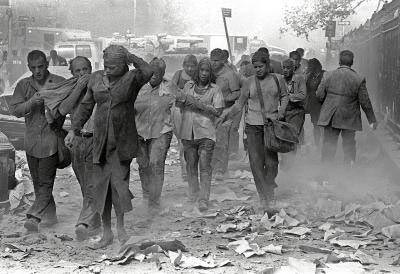
Instability abound, the Western
world finds itself precariously balanced: for with power comes a duty of care.
If it is to lead nations from the threat of external invasion, it firsts need
look within and proactively protect its citizens.
9/11 serves as an unheeded
warning. Most remain unprepared for an attack and many remain ignorant of the
country and customs of those being invaded. The media breaches its own duty in
not being a reliable source of information.
No longer can terrorism be swept under the rug: it is public domain.
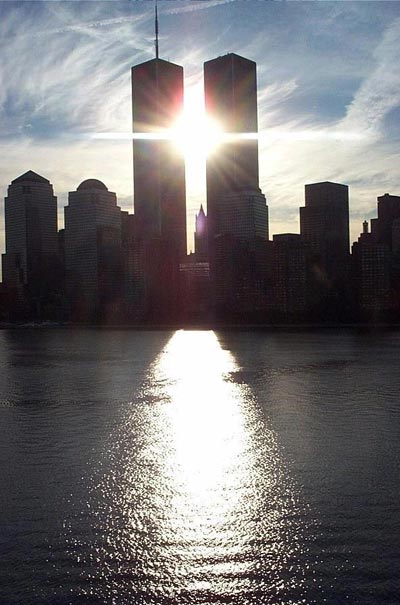
Currently, the Manhattan skyline
is dominated by the spectre that stands at 1,368 ft. Soon, it will be joined at
that height by World Trade Centre 1, or Freedom Tower. With Freedom comes the
hope that the current ideology of terror will be washed by the waters of the
fountain that circle the Twin Tower base: otherwise, there will progress a
stalemate of fear, a waiting game of attack and consequence.

 |
| Countries where there have been attacks with more than 20 victims since 2001. |
-John Boehner
