Showing posts with label London. Show all posts

Monday, 10 June 2013

Frankfurt's Forgotten Riots

“Look at you, stood protecting your blood money! You’re no better than politicians. You’re bribed by the money that is making your nation weak and is stealing from us every day and you don’t even realise it!”

Over the past two years, the Arab Spring has seen revolutions and demonstrations sweep Northern Africa in a hot fury that has both shocked and been viewed in awe within Europe. Corruption, economic hardship, and threat of wars all contributed to the radical movements that have unseated governments and autocrats alike.

This fire seems to have sparked a new European movement in itself, and this was certainly ablaze in Frankfurt last weekend. Whilst Turkish riots in the corner of Europe spread across the news as the most interesting and harrowing examples of recent protest in the Western world, the demonstrations at the Economic Central Bank of Europe went seemingly unreported in comparison.

There is no doubt that there is an economic boss in Europe, and she wears the name Angela Merkel. Germany, the economic powerhouse of Europe, has earned her place to dictate economic measures across the Eurozone, providing the backbone of the European economy. But disruption and distrust of the system sow seeds of further weakening across Europe.

Riots in Greece and Turkey are no mere trifle. The countries face growing rates of unemployment, restricted economic growth and limited financial trades. The former is set to accept a set of stringent measures by which it is to be provided with a bail out that by no means appeases the nation, who are baying for European blood amidst the onset of a further downturn.

However, when the Germans themselves come to contest the Euro, the writing really is on the proverbial wall. Here, where Berlin is seen as a symbol of democracy, the population is not likely to sit and be ignored regarding the running of their country a second time. Whether a wall is physical or fiscal, the outpouring of resentment from within the European banking capital in Frankfurt is concerning.

The force of the German police certainly took the threat seriously, regardless of the world opinion. Shutting the main financial district and sending in excess of 70 police vans to line the boulevard, forces were armed in full riot gear, lining the streets with barbed wire, and sending water cannons in to assist on the ground, helicopters to monitor from the air.

European economy is not just centred on Germany, it arguably thrives from Germany. While there have been numerous capitalist crises in the past, the gravitas of the current financial situation has still to show its boundaries. This permanent state of crisis has now come to disillusion new generations of activists and unemployed as the central countries of Europe and the US see credit ratings slash and further recession despite never ending political will to slow the rate of cuts and boost markets.

The austerity measures proposed by the so-called troika, consisting of the ECB, International Monetary Fund (IMF) and the European Commission have not reduced the national debts of the European countries. An increase of taxes and cuts of governmental social programs they promote have actually worsened the situation, deepening recession and increasing unemployment in the EU dramatically.

Since protests are now igniting not as isolated European events, but increasing in frequency and local, it shows that there are deep roots to these problems. The ‘fad’ of Occupy London is called to mind. At once, the threat doesn’t seem so unique: removed from isolation, the plight of all those that were at once both strong and desperate enough to ‘siege’ the London banking district for weeks in search of resolve is both revered in new merit and feared in equal measure.

In previous years, riots have all too often appeared incoherent and inchoate. With all but limited aims and reasons, most of these disruptions have garnered little support. But the controversy begun with ‘Occupy’ continues to threaten in new forms. The controversial 2011 riots in the UK may have started as a peaceful protest against a shooting, but an abhorrent mix of social problems ignited the violence that followed.

Sweden now faces nights of unlawful action, as the unemployed take to the street to violently protest at the state of the economy in their nation. Despite being amongst the richest nations in the EU, there has been a significant increase in the level of youth unemployment here, as with many other parts of Europe. As with the London riots, the trigger seems to have been a police shooting that has opened the floodgates of national resentment. Once topping OECD rankings for low poverty, the country is now slipping further and further down the table, with Europeans crying out for change.

Of course, things could be worse. Sweden has the EU’s lowest percentage of low-wage earners. The honour of largest low wage earners goes to Germany, with 22.2% of employers receiving minimum wage. This is possibly part of the reason for the massive outburst in Frankfurt.

There appears large discrepancy between the image of Germany, the European Powerhouse, and the economic wellbeing of its residents. Looking in, the country surely has fared better than most in the recession. But the cracks are self-evident. Low wages coupled with increasing inflation and continued bailouts, funded by the German public en masse if protesters would be believed, seriously weakens the economic standing of the EU giant and its residents.

Austerity measures on EU citizens are just scratching the surface of the potential violence of the masses. When the 99% drive the economy itself, their voices can certainly impact the future of fiscal measures, but would 99% control solve any problems in itself? Probably not, and the face of uncertainty only makes us worry and riot all the more.


Friday, 9 November 2012

The Value of Work Experience

Originally written for The Guardian Comment is Free.


Another busy week is ending at The Guardian. A busy week which I've experienced first hand, taking up a placement opportunity at the newspaper. I've covered activist Malala, sleuthed James Bond's espionage hot spots, and been deluged with storm waves following Sandy on the live blog. But I'm not about to walk up to the news desk and demand a pay cheque for the week. When I leave the office this afternoon there will be no cash in hand for my hard work, but experience, the value of which is immeasurably greater.

Experience is a compulsory element of the graduate CV, even on a tight budget. Gone are the days when fresh faced University leavers could walk into an office with a smattering of A Levels and a role of paper from a Red Brick institute: education is no longer indicative of employment.

In the wake of the indiscretions of Blair's office, my friends and I soon found ourselves discussing the inevitability of unpaid experience as the only means by which to further our career prospects in a stormy recession. Rising youth unemployment and an increase in degree holders makes it almost impossible for companies to commit to contracts and long term employment without some proof of previous relevant work.

The almost universal problem in accessing this experience though transcends from the fact that a large proportion of the most established and reputable internships will be placed in London. I, like many of my friends, do not live in the capital. (Un)surprisingly, London just so happens to be expensive and out of many budgets. This fact severely limits and disables the options of many undergraduates searching for that big break. Yet talking with a friend who just started an internship in London last month, she said that “there was no alternative” to coming to the city, “no matter the cost”.

According to Intern Aware, not only are the majority of placements in London, where the cost of living is the highest in the UK, but The IPPR estimated in 2010 that there were around 100,000 unpaid internships in the UK. Of course, the problem is that unpaid internships are corrosive to social mobility and opportunity in a number of circumstances. If you cannot afford to support yourself for the period of the placement (fortunately for myself, this was achieved cheaply by bribing my aunt with some chocolate and leaving her a bottle of wine this morning), then there is little chance of substantial opportunity to further your horizons. Perhaps one placement is justifiable, but two or three consecutive stints of unpaid work leave students add a gaping hole to their already spiralling debt.

However, for my part, work experience is something that every student needs to acquire, regardless of wage. This is probably a divisive and contentious view, but let's be clear, I'm not one of these stereotyped students that can ring up mummy and daddy and ask for some money to be transferred so as I can enjoy London. My parents can't afford that additional expense, and frankly, nor do I expect to put that burden upon them. The student loan is also not the endless pot of Irish gold it appears to be in Freshers Week.

Yet, work experience and internships completed for free say a great deal more about the competency and dedication of the young employee. In a climate where companies continually bemoan the problem of telling applicants apart, those who have volunteered themselves to complete placements with minimal monetary support display a vivacity so essential to the work place (especially in the media).

Companies provide these placements to people entirely untrained, with little experience. Despite the brevity of the work, paid staff will have to take time out of their schedule to train, advise, guide the intern and is probably under constant supervision. Not to be condescending, but it's hardly realistic to expect to walk into The Guardian and land the front page whilst on placement.

Just as you pay for the service of university, work experience is something you pay for by making sacrifices of sorts. It's a privilege, not a right. Not that this statement should detract or act as an exoneration of Tony Blair's office. It's just, from the student outrage, you'd be forgiven for thinking this was a new problem.

Working for free is inherently integrated into the system of employment. I've covered some big issues this week for The Guardian: do I feel exploited? No: I feel privileged to be given this opportunity, to have some world renowned and respected journalists that lead their field have faith in me to turn out a piece suitable for publication.

Rewriting my CV this weekend, I'll be able to send out my portfolio with a massive boost to my prospective employers. For a short term inconvenience now, I stand to benefit enormously in the future. No one had really questioned this practice until now.

Perhaps a system in which work placements offer means-tested assistance, in a similar way to the student finance service, would proffer a much more accessible work place and encourage a larger number of students who believe their backgrounds hinder their progress to look into experience. I've hardly had to pay for anything this week, but it would be nice to go up to the news desk editor, bung a load of Oyster card receipts in his hand and get £30 back. For a student, that's a two-week food shop. My train fare would feed me until New Year's.

Unpaid internships may present themselves as social engineering in another format because of their obvious limitations, but they are social characterising. Hand in hand with the experience comes invaluable training and character building by observing the tough post-university world through a different, direct lens.

The comments of my friend in a London bar earlier this week strike a chord: “no alternative, no matter the cost.” If we expect employers to take young new employees seriously, we should first demonstrate our dedication to our crafts. The school of “something for nothing” is no longer a sustainable attitude for any graduate.

Tuesday, 28 February 2012

Democracy Occupied.


The closure of the Occupy London camps is a closing down of democracy.

Police and baliffs in charge of evicting the protestors moved in on the St Paul’s site last night, February 27th, and continued to clear the area of demonstration this morning. The move comes following a court ruling to have the camps and occupants disbanded.

Appeals to the decision were denied in a move that only adds to the gravitas and reasoning behind the goals and aims of those in charge of the movement.

Occupy London set up shop against capitalism in October last year and has remained a permanent fixture just a little way off the London Stock Exchange for more than four months. Following the example of protests in America, the sit-in phenomenon took off worldwide, and had established itself as part of the landscape outside St Pauls in the capital.

However, the clearing of the sites took little time last night, as many simply moved on as a large force of police closed in on the area. Some were resolute and built a small structure to stand their ground, but within a few hours, this too was dismantled. All that remains of the proud symbol of anti-corporation greed is being ‘cleansed’ in a deep clean. I say ‘cleansed’ because the root of the issue has not been dealt with.

Mayor Boris Johnson took the opportunity to say that he is “glad that finally the law has taken its course”. It would appear that the mayor oversteps his position as a leader of a free government, by suggesting that this prevention of free demonstration is a positive act.

Within the first week of its occupancy, the demonstration had been contained and caused little, to no, disruption in the area: instead blending into the background, heckling peacefully at professional businessmen and women who were the cause of their misery.

London’s trade remained undisrupted.

Now, with the removal of tents and sleeping bags from the St Paul’s steps, but a claim that “The corporation made it very clear that they have nothing supposedly against protest”, there is all the more ammunition to mount daily assaults on the London Stock Exchange area.

Moving the protesters from their camp simply provides the motivation for the activists to move onto the next stage of campaigning, more disruption, more force and presence outside the buildings of the exchange. After all, the only part of the protest with which the law took umbrage was the make shift settlement and sanitation.

Daily demonstrations provides more of the furore and direction needed to ensure a more noticeable effect occurs, a more positive change. After all, if the people working in the Square Mile are disrupted daily, so trade is impacted.

Although there is nothing of the physical camp remaining, certainly its ideas and ideals are still bubbling with zeal around the streets of the capital. The greatest achievement of the camp came in its early days, when there was realisation that those regulating the money, the trade, the jobs, could be wrong-footed and undermined. If the removal of the camp is to reignite this spark, then the authorities could have unwittingly done more harm than good for their cause.

Whilst I do not agree with the removal of the camp, as it brings with it a sense of oppression, or underhand court dealings, there was certainly for the most part no cohesion between public and protestors. Within ten days, the public interest had dimmed and the camp was not necessarily speaking for a majority.

With undefined goals, the next step for the campaigners should be to regroup and outline some aims before continuing. Whilst the group had noble sentiments in the time of credit crunch, recession and high unemployment, there was no long-term solution to capitalist flaws.

Even if the Occupy movement was not wholly formed, it is the closure of camps that is the most striking in a country of free speech. As a society broken by capitalist misdemeanours, even should we not agree with what is said, we should defend the right to say it.

Saturday, 28 January 2012

Track Two... A Departure to 2026.

Confirmation that the HS2 rail link between London and Birmingham would go ahead earlier this month was met with little applause.

Many people have slammed the government project due to the routes cutting through “areas of outstanding national beauty” and the plans had to be adjusted last minute in a ditch effort to get the plans past parliament.

Indeed, the majority of disgruntled peoples who object to the scheme fall under that umbrella acronym of NIMBYs (Not In My Back Yard), being persons who would normally encourage the development of such a (rail) infrastructure and yet refuse to show support as it may disrupt their lives ever so slightly.

My issue is to the contrary. The HS2 link does not go far enough.

Rail travel within Britain, where the mode was first pioneered, has become slow and unreliable. The passengers who depend on the rail links are subject to overcrowded carriages, infrequent trains and expensive costs. Most of the UK system still runs on lines that were introduced in the late Victorian era, and this is not suitable for a 21st century country.

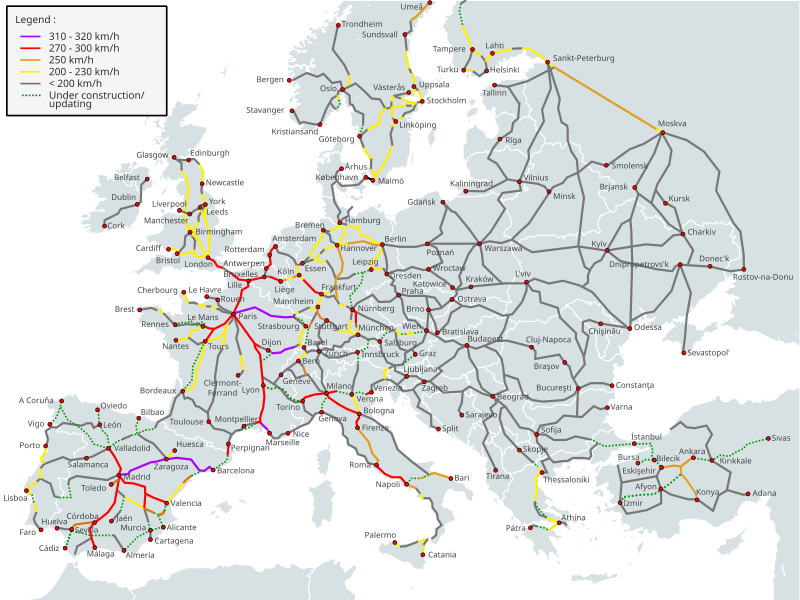
High speed rail has been expanding across the EU since the 1980s and has had significant investment in France, Germany and Spain, amongst others. Routes available on high speed service across mainland Western Europe is unrivalled on this continent; yet even within Germany before full roll-out, there are plans and schemes for Maglev-esque vehicles, increasing speed, efficiency and lowering costs by reducing friction.
Europe Railways in 2011, highlighting major high-speed investment in France, Spain and Germany.

Yet Britain appears completely unconcerned with the benefits that a modern rail system provides.

The small scale expansion into High Speed rail was introduced by the channel tunnel as recently as 2007 – seemingly forced by Europe as trains on the French side of the channel were capable of performing at speeds almost double the London-Folkestone average. For no real reason other than lack of investment.
Promise of the first major expansion to Birmingham is not to be operational until 2026. Any further links, preliminarily to Manchester and Leeds, will not open until 2034 at the earliest. The chances of this type of rail reaching Scotland before the 2040s? Remote to non-existent. There is a real lax approach as to the implementation of the scheme as a whole.

It is confounding how a line that promises a 50 minute reduction between London and Manchester and an hour reduction between London and Leeds is not being capitalised upon sooner.

Already, the Birmingham link alone is projected to generate some £43.7billion of wider economic benefits and generate £27billion in rail fares on these lines alone. Not to mention that the need for a wide spread introduction of the links, in every aspect from administration, to HR, to contracting, could create countless jobs at a time of severe economic crisis.

Longterm, the service would offer job migration. A person living in Manchester could work in London. A person living in Glasgow could work in Manchester. It opens up an entirely new field of connections and job prospects in areas of the country that were once reserved for those within a certain radius. Let’s face it, if Scotland becomes independent, Edinburgh will need a high speed link to London and from there to Europe. Current travel time between London and Edinburgh sits at an unappealing 4.5-5hours. With HS2, that could become 2.5 hours.

Moreover, the lack of enthusiasm for quick installation is unnerving. Firstly, the current proposals do not integrate the line into the National Rail system completely, having the Birmingham terminus exist in its own self-contained unit instead of arriving into Birmingham New Street, the central transit hub of the West Midland city.

Further, as previously mentioned, other European countries are already abandoning this train of thought in favour of other more advantageous railway systems: notably, the greener, more efficient and more cost effective Mag-lev, which is becoming the norm in Japan and a sensation in China.

Where might this innovative infrastructure have been tested then I hear you ask? None other than Birmingham, UK.

By the time the High Speed Line in its current incarnation is implemented to anywhere near the capacity required of the British public, it will already be defunct and an obsolete antique before introduction. The entire system need be bypassed in favour of more cutting edge and innovative means of transport.

If sufficient hands were contracted, lines connecting London to Glasgow, via Birmingham and Manchester, and London to Edinburgh, via York and Newcastle are not out of the question before 2025-2030. Yet the government is unwilling to invest in its own country, whilst the British railway, jewel of Victorian invention, is set to innovate countless people’s lives across the world before the decade is out.

With many lines already operating at over 80% of capacity at morning peak, High Speed is the only way to ensure the country keeps moving.

Wednesday, 30 November 2011

My Tram Experience: Racism vs the people


The appalling and shocking views of the woman on the Croydon tramlink have led to controversy over the past week.

The viral video received thousands of hits after being uploaded and rose to prevalence through the trending and sharing of social network users. In a whirlwind domino effect, widespread news outlet took a hold of the piece, broadcast the video, slammed the mother and police were informed.

Now, 34 year old Emma West, whose views about immigrants were extremely racist to say the least, is in police custody and awaiting a trial for her foul and abusive language used to attack other innocent passengers on the rush hour London tram service.

West has been remanded in custody until Tuesday December 6th, but her comments are much more the subject of debate than the sentencing.

The difficulty of the hearing hangs on the crux of freedom of speech. Whilst I by no means condone the harsh opinions of Ms West (following my own viewing of the video, I sat in a stunned silence for some time), her words are surely safeguarded under human rights acts. Freedom of speech and of opinion are constitutional requirements in this country and it in order to maintain such standards, it would appear the case should be laughed out of court.

And here, the phrase is quite hurtful. Because why should such a case be laughed out of court? In moves to avoid dictatorship, it would be in the interest of all peoples to be able to speak freely without consequence.

However, no law goes untested and restrictions need ensure that freedom is managed and controlled: otherwise, we would all be at liberty to abuse other members of society: and such fragmenting is all too reminiscent of the August riots across the country.

Indeed, Ms West’s misunderstanding and lack of prowess regarding those of foreign origins is probably much more widespread than we would care to admit and the views of racial superiority that were once commonplace are certainly subsurface factors in tensions between different groups.

Of course, there comes a point where such tensions boil over and not only were Ms West’s allegations proof of this, but the fellow passenger who was quickly aggravated by her onslaught adds to our comprehension of the problem. Thankfully, another commuter calmed the retaliator with some speed: for otherwise, the focus of the video may have been overshadowed by a supposedly unprovoked violent attack.

Balancing public protection and freedom of speech comes with a fine line. However, due to the incompatibility of the two, it is common that free speech come first, lest further action and civil unrest take place.

Yet this only leaves malcontent to breed. Won’t somebody please think of the children? One of the more distressing aspects of the video for myself was watching the toddler sat on Ms West’s knees, apparently oblivious to the shouting mother. Either oblivious, or numb to its consistency as a feature in his life. Hopefully, the child is being placed with other family members in order to ensure a much more rounded and happier youth – the difficulties in impoverished London boroughs are known all too well by any city residents.

However, what next for Ms West? Rehabilitation of sorts? Counselling? Social service intervention? Whatever a judge determines is satisfactory course of action to educate the woman of a proper sense of community… even if that is just to keep xenophobic comments to oneself on the public tram.

Nonetheless, this uncomfortable experience is the most daily and frequent occurrence of casual racism. For ‘unlucky’ Emma West, one fast-thinking commuter recorder her, thousands of other people brand and scorn without a comeuppance.

More, do we judge without knowing the facts? Had Ms West had an unfortunate incident with some person of foreign origins herself? Was she drunk or drugged? Is she recently bereaved? Or was it simply a bad day?

Our understanding of such people is key for social unity. Otherwise, we risk widespread riots on repeat. Of all the reasons suggested for the summer riots, this is but one of a never ending list of possibilities.