Showing posts with label Europe. Show all posts

Wednesday, 9 May 2012

Redefining Europe?


In a historic moment, this weekend saw a new president elected in France. But this is not a simple handover from one leader to another. French politics has been shaken and the results are clear to see.

Francois Hollande received around 52% of the vote to wave Sarkozy from office. But Hollande rise to President-elect was anything but smooth: yet perhaps the most overwhelming hurdle was the inherent psychology of French citizens, apparently predisposed in favour of right-wing politicians.

Sarkozy’s Union for a Popular Movement (UPM) party was a centre right organisation, and ever since the 90s, the French presidency has exclusively belonged to the right. More so, there is only one blemish on the right’s record of power since 1958: Francois Mitterrand, who served the country as president from the 80s till the mid-90s, is the only left wing leader in more than half a century. On top of that, Sarkozy is the first French president not to have won a second term in over thirty years. Certainly, the statistics were stalked in the incumbent head-of-state’s favour.

Therefore, whilst the media may be drawing attention to numerous bits of luck on the part of the incoming president, and a multitude of misfortune on the part of the departing, there was first and foremost a seeming political allegiance, a political bond, between president and people that needed to be severed.

Perhaps the legacy of Mitterrand still holds coinage with voters in the European country. After all, Francois successfully deployed a substantial economic turnaround, made sweeping technology changes, supported various activist movements and carefully balanced the power of France within Europe and the world. His period of power produced a France that was not only one of the strongest countries at the close of the twentieth century, but in its strongest position across the century as a whole.

As such, in times of similar economic failings, a possible identity crisis and continued French resistance and demonstrations against French rulings, Hollande appears a candidate very much in touch with his people, dubbed Francois II (signifying him as the second coming of Mitterrand). Other headlines proclaim him as ‘Mr Normal’.

Indeed, French presidencies of the late twentieth century were either held by old, hardened politicians, or apparent upstarts who had rose through their party ranks too quick for sufficient experience.  Here is an elect who not only has the fine-balance of experience and youth on his side, but is so seemingly straight-forward, if not a little reserved, that he has won the French people with his honesty and genuine persona.

A front-page "Letter to Mr President" by Francois-Regis Hutin in Ouest France wishes Mr Hollande "good luck". The paper says that "we count on you to arouse the dynamism of all the French... to reconcile the French, to help overcome the split between the included and the excluded, young people and old people, town and country, workers and pensioners, rich people and poor people."

Of course, this tackles the failings that are laid at the steps of Sarkozy’s regime. He was either despised as a friend of the rich by the left, or seen as the man that broke his word by the right, or by most as the man that promised reform, began to make steps in that direction and stopped far short of completion.

These issues need be addressed by the new President for sure. His period in charge will prove pivotal certainly to the shape of the French twenty-first century, if not for the most part of the next millennia. Hollande will govern a country where, as the historian and economist Nicolas Baverez says, "By 2025, we will know if France still ranks as a leading nation in the world."

Yet despite the new appeal of Hollande’s practicality and placidness, his offer of change and consolidation, there is remarkably little difference between the centre left and centre right candidacy campaigns. The deficit will be tackled slower under Hollande, and with more dependence on taxes, but otherwise, there is not too much that would rock the boat about this leader.

His trail, though igniting people with the promise of a zero deficit by 2017, has left little impression of the long term policies and positions of the President: rather, people have been swept along with the fervour of change, the promise of Mr Normal. After all, Hollande appeared less focussed on austerity measures that were favoured by his predecessor and Merkel. And with their policies only bringing about rising unemployment and debts, the public support has suddenly dried up for their strict measures.

All that is sure of Hollande’s term is that his decisions will carve out the path of future France: either rising like the beacon of the Eiffel from the storm of the Seine, or reaffirm dwindling power that would leave French surrendering to the mercy of Germans and Britons alike for the third time in a century.

Saturday, 28 April 2012

Economics Straight and True


Earlier this week, it became official that the UK was in a double dip recession; an announcement that had been softened somewhat by previous data that suggested the UK economy had once more begun to shrink.
Now there are calls for the government to alter their course of action so as to encourage growth before the new dive becomes irreversibly damaging to trade and economic prospects.

However, austerity measures already in place took some time and considerable budget planning to come into force and it is highly unlikely that a swift change of course will come by the end of the month, or summer for that matter.

No, the government will cling to a belief that whilst many other countries, both across Europe and the globe as a whole, were reassessed and had their credit ratings slashed a few months ago, Britain was spared in part thanks to these current policies.

It is no little truth. Of course, the trend of growth, strength of the sterling and increasing import/exports all had a swaying hand on the decision, but a key factor in the assessment process is the perceived overall management of a country’s finances. Fiscal priorities from Westminster over the past twenty-four months have been second to none and, whilst the hard medicine approach has drawn parallels with the unpopular measures of Thatcher, now (as then), there is still an overwhelming feeling of support for the government as they remain resolute in their course of action.

Indeed, polls at the beginning of the month, following the budget report indicated drops for the Conservative party, but these were immediate back-lash reactions and not measured voices who had considered the situation.

A situation that is, at best, precarious. Sudden shifts in strategy could in fact damage the overall economic efforts. Initial reaction to another statement of new measures would see widespread panic throughout the City that would in turn spark a weakening pound and a possible rush on banks.

Not to sound overly apocalyptic, but the trust that the public and businesses place in government policy is a fine balancing act. Even the slightest hint of disruption could threaten the stability that has slowly ebbed its way back into consumer and business life.

Moreover, with Spanish unemployment at a new high, continued Greek unrest, and further burdens on Germany as AAA lone ranger of the Eurozone, the British need to put support behind government efforts to consolidate progress so far achieved. With the costly problems facing Europe, our markets need to continue to prosper, or else both pound and euro will undoubtedly ride down the abyss together, so inherently linked are the two zones.

Whilst the budget measures are unpopular and few benefit from the changes, it would be unwise to declare the policies as inappropriate and unsuitable to the current climate. The phrase “we’re all in it together” still rings true in ears across the country: only in a resolute front of support can businesses emerge from the staggering financial crises and people become more liberal about their expenditure. Riots like last summer show the potential fragmentation that lurks underneath our society, and similar disruptions seen across mainland Europe in country’s with governments weaker than our own are testament to the need for a straight and steady course, perhaps even to protect us from ourselves.

Monday, 13 February 2012

A Greek Tragedy.


Shops looted, buildings blazing, a city in panic, mobs raging.

The scene could be London last August, or any major city with subsurface tensions. This is Athens, where friction has given way to violent protests amidst the latest economic deals from Brussels.

Despite the promise of an election in April, the Greek people are none the more encouraged to retain faith that their money is safe. There has been a rush on banks and cases of citizens sending money to accounts abroad. The economic crisis could make or break underneath the shadow of the acropolis, once a symbol of Greek might and myth.

Now, the dreamy myth is long since dispelled. The latest emergency relief package from the EU and IMF is projected to offer an injection of approximately €130 billion, should they receive proof that Greece is implementing its latest austerity measures.

However, the unrest and winter of discontent only breeds malaise amongst the Greek government. On Saturday night, parliament may have voted in favour of new spending cuts, but with almost 50 deputies rebelling, battle lines had clearly been drawn on an epic scale.

If the deal is not closed however, Greece could default as early as next March.

Therefore, the balance of power rests on the foreign leaders wanting a promise of austerity measures versus the Greek electorate, who resent the interference from the West and are seeing their country’s economy downsizing for the fifth year in a row.

In this second programme of cuts, ministers in Athens have pledged to slashing 15,000 public-sector jobs as part of a longer-term strategy to get rid of 150,000 civil servants. In addition, there have been moves to reduce the minimum wage level by an overwhelming 20%, whilst also altering the labour laws to ensure easier staff dismissal.

None of this is good news for the populous at large. Greek is already one of the poorest EU countries, with a low GDP per capita, and their borrowing has spiralled out of control, despite being burdened with a set of sweeping cuts last year.

If Greece were to heed to calls for the return of its Euro predecessor, the drachma, then there were be further turmoil across Europe, as funds pumped into the economy were annexed and other countries were made to subsidise the lost revenue. In addition, there would be mass movement of Greek Euros abroad, so as the people could capitalise on falling trade values and earn more money.

When concerns first started in 2009, Greece was burdened with debt amounting to 113% of GDP - nearly double the eurozone limit of 60%. Ratings agencies started to downgrade Greek bank and government debt and this has only led to stifled growth and the increase in debt. But how had EU regulations not picked up on the expenditure that saw such huge waste of resources?

The possibility is that Greece could be forced to leave the Eurozone so as there is not a continual stream of lost wealth. But whilst this might only disrupt Europe for a little while, the impact on Greece would ensure that it was hampered by debt well into the latter half of this century, with little consumer trust, economic growth, or trading partners.

The outlook is bleak then. With an uncertainty as to whether the Greek can meet Eurozone demands, public backlash and a potential run on more financial institutions, the recovery is far from certain. There are those who belief that another loan from Europe just kicks the inevitable further down the path and that reductions in deficit by 2020 are unrealistic.

Certainly, the play before the Acropolis today is a Greek tragedy.


Saturday, 28 January 2012

Track Two... A Departure to 2026.

Confirmation that the HS2 rail link between London and Birmingham would go ahead earlier this month was met with little applause.

Many people have slammed the government project due to the routes cutting through “areas of outstanding national beauty” and the plans had to be adjusted last minute in a ditch effort to get the plans past parliament.

Indeed, the majority of disgruntled peoples who object to the scheme fall under that umbrella acronym of NIMBYs (Not In My Back Yard), being persons who would normally encourage the development of such a (rail) infrastructure and yet refuse to show support as it may disrupt their lives ever so slightly.

My issue is to the contrary. The HS2 link does not go far enough.

Rail travel within Britain, where the mode was first pioneered, has become slow and unreliable. The passengers who depend on the rail links are subject to overcrowded carriages, infrequent trains and expensive costs. Most of the UK system still runs on lines that were introduced in the late Victorian era, and this is not suitable for a 21st century country.

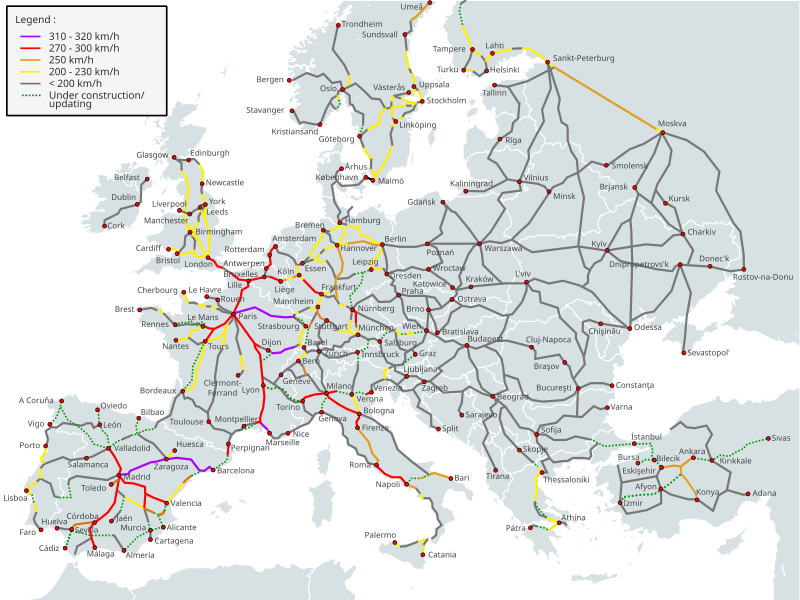
High speed rail has been expanding across the EU since the 1980s and has had significant investment in France, Germany and Spain, amongst others. Routes available on high speed service across mainland Western Europe is unrivalled on this continent; yet even within Germany before full roll-out, there are plans and schemes for Maglev-esque vehicles, increasing speed, efficiency and lowering costs by reducing friction.
Europe Railways in 2011, highlighting major high-speed investment in France, Spain and Germany.

Yet Britain appears completely unconcerned with the benefits that a modern rail system provides.

The small scale expansion into High Speed rail was introduced by the channel tunnel as recently as 2007 – seemingly forced by Europe as trains on the French side of the channel were capable of performing at speeds almost double the London-Folkestone average. For no real reason other than lack of investment.
Promise of the first major expansion to Birmingham is not to be operational until 2026. Any further links, preliminarily to Manchester and Leeds, will not open until 2034 at the earliest. The chances of this type of rail reaching Scotland before the 2040s? Remote to non-existent. There is a real lax approach as to the implementation of the scheme as a whole.

It is confounding how a line that promises a 50 minute reduction between London and Manchester and an hour reduction between London and Leeds is not being capitalised upon sooner.

Already, the Birmingham link alone is projected to generate some £43.7billion of wider economic benefits and generate £27billion in rail fares on these lines alone. Not to mention that the need for a wide spread introduction of the links, in every aspect from administration, to HR, to contracting, could create countless jobs at a time of severe economic crisis.

Longterm, the service would offer job migration. A person living in Manchester could work in London. A person living in Glasgow could work in Manchester. It opens up an entirely new field of connections and job prospects in areas of the country that were once reserved for those within a certain radius. Let’s face it, if Scotland becomes independent, Edinburgh will need a high speed link to London and from there to Europe. Current travel time between London and Edinburgh sits at an unappealing 4.5-5hours. With HS2, that could become 2.5 hours.

Moreover, the lack of enthusiasm for quick installation is unnerving. Firstly, the current proposals do not integrate the line into the National Rail system completely, having the Birmingham terminus exist in its own self-contained unit instead of arriving into Birmingham New Street, the central transit hub of the West Midland city.

Further, as previously mentioned, other European countries are already abandoning this train of thought in favour of other more advantageous railway systems: notably, the greener, more efficient and more cost effective Mag-lev, which is becoming the norm in Japan and a sensation in China.

Where might this innovative infrastructure have been tested then I hear you ask? None other than Birmingham, UK.

By the time the High Speed Line in its current incarnation is implemented to anywhere near the capacity required of the British public, it will already be defunct and an obsolete antique before introduction. The entire system need be bypassed in favour of more cutting edge and innovative means of transport.

If sufficient hands were contracted, lines connecting London to Glasgow, via Birmingham and Manchester, and London to Edinburgh, via York and Newcastle are not out of the question before 2025-2030. Yet the government is unwilling to invest in its own country, whilst the British railway, jewel of Victorian invention, is set to innovate countless people’s lives across the world before the decade is out.

With many lines already operating at over 80% of capacity at morning peak, High Speed is the only way to ensure the country keeps moving.

Tuesday, 24 January 2012

Downgraded European Economies is a Punishment for Germany.


As the Eiffel Tower sits overlooking the Seine in the centre of Europe’s capital of love, it appears that Standard and Poor, the international credit rating agency, have fallen out of love with the French capital.  

Downgrading of nine European Union economies last week did not come as a surprise, per se, but remained a bitter blow, especially to the second largest Eurozone economy. Rating changes for nine countries highlights the need for new austerity measures, before introducing growth plans.

Perhaps this is the reason Britain remains unchanged in S&P’s poll: Cameron’s government moved quickly to introduce cuts and the fact that these measures have been undertaken without direction has been rewarded from the worldwide monetary agency.

Without doubt, Britain’s position is far from safe: while the short term consequences see a gain in GBP strength and trade prospects on an international scale, the intrinsically linked economies of Europe are a fragile set of dominos. A single collapse at this stage of the crisis could prove the kindling for an explosive series of economic shortcomings and bailouts.

Indeed, plans introduced to cancel 70% of Greece’s debt last Friday are but moves to buy time for the Euro and all related economies.

Whilst it is believed the move may help Greece to start to implement new means of recovery that will slowly abate the spread of financial interdependence, the wiping of such an astronomical figure from the central funds of Europe is equivalent to pulling the plug on a vast resource of wealth. With fewer countries classified AAA, the missing money could prove to be nigh on impossible to replace, meaning that it would undermine the significant advances made in industry over 2011.

Should such an econopocalyptic event pass, it is likely to trigger debt that cannot be undone within our lifetimes.

France’s image as one half of the economic megaforce upholding the Eurozone has now been shattered. Sarkozy’s right to stand on a podium alongside Merkel has been removed: former foes had been presenting a united front as the 17 countries that use the euro face their biggest crisis since World War II. Now, whilst a blow for the president, concerns should shift from where France went wrong to where Germany now finds itself.

Economically, Germany is on the precipice before the abyss. All of Europe looks to its €211 billion ($267.32 billion) contribution to the Eurozone rescue fund as a source of saviour. Although Luxembourg, Finland and the Netherlands all maintain their AAA rating in addition to Germany, the mother of the Rhineland is able to boast a donation to the Eurofund that is more than treble that of the other three combined.

Germany is once again isolated in the centre of countries that threaten it: no longer the supposed threat of invasion, but the threat of siphoning all the funds possible for ulterior economic issues.

Relative strengths and weaknesses of key economies have been realigned by the changes and Germany becomes more vulnerable to credit crisis the more that its own funds are charged with the duty not only of small periphery nations, such as Greece and Portugal, but large central blocs, as France and Italy.

Any increase in bailout costs comes from German pockets and this appears to be something that the German electorate may not bear with merely a customary grumble too much longer. This could lead to potential referendums on the amount Germany puts into the fund, or even on the Euro itself.

However, the cost of breaking up the Eurozone itself could be catastrophic as billions of Euros are lost in every area from trade to administration and all problems in between. In fact, the relative weakness of the surrounding economies at least makes German products more competitive, which means Berlin earns more capital.

All the same, the opinion of the voter would depend on the projection of their outlook. Germany, likely to reassert itself as the strongest economy before European counterparts could still see benefits from a break in the single unit currency within a decade or two. Markets would always seek the hub of enterprise and exports offered by the central state.

The risks of both cases are, unfortunately, war. Ironically, the Franco-German alliance now enters a turbulent stage wherein the two countries sit on the crux of imposing a disaster on the rest of the economy, continent and world.

Should Germany continue to support its Eurozone counterparts, there may emerge a sentiment of anger and resentment that would see a war break out due to a lack of appeasement. On the other hand, if Germany were to break its ties, it could grow strong amidst a state of turmoil and seek further expansion in order to capitalise on new found economic prospects. And who could say that such a route would be devastating – the application of German stratagems could provide economic balance further than its current boundaries. Or should Germany leave, other European countries may feel abandoned and declare action as a last ditch effort to prove their own flailing might in the face of German capitalist gains.

After all, one of the main contributing factors of the Second World War was the sheer amount of economic wealth that was drained from Germany by other European countries. But then, when have we ever learnt from history?

Sparkling over the night waters of the Seine, the Eiffel Tower appears an oversized, abandoned Christmas decoration, spreading little warmth to the heart of Paris, threatening to be washed away by the tide of debt on which it is founded.

Saturday, 3 December 2011

Autumn Statement Readjusts Economic Vision.


Amidst continuing economic misery and the prospects of further strike action, the Autumn report from George Osborne was quite the focal point of the week inside parliament, no matter what happened throughout the rest of the capital and the country.

With repeated promises of grand strategies and new hope, PM David Cameron has made several hints in recent interviews that this would be an announcement which would once again set Britain along the path to recovery and financial stability.

As expected, the statement did little to improve positivity, yet it is difficult to deduce how far there are failings in this report or its predecessor.

Shadow chancellor, Ed Balls, reacted to the speech by declaring Osborne’s plan was in tatters and concluded that it had been “a colossal failure”. And whilst the announcements in the House of Commons were far from a success, a colossal failure appears somewhat extreme a branding.

A shift in direction has been long overdue: and by employing such a course of action, the current government may have been able to steer clear of certain failings that are current plaguing the Eurozone dominated by Merkozy.  

Indeed, as expected and reported heavily on earlier in the year, forecasts have shrunk and growth is expected to be minimal for the coming two years (which is all the more concerning considering the Olympic Games should provide a boost that is not at all evident in the statistics). Add to this the fact that instead of reducing the deficit, the government is set to borrow an extra £111bn over the course of four years: a projector that means it will have spent more than Darling did previously.

However, it is difficult to condemn the move as liberally as Balls challenged. Without a change in tact, there would have been serious risk of falling into the Eurozone problems of cuts vs stability.

No doubt, the balance between the two is difficult to attain, but this statement goes some way to redress the issue. Money has been released for key areas of growth: infrastructures such as motorways, rail systems and housing complexes all benefit as well as several key industries. The idea is to promote growth that will outlive excessive government spending. By starting the process, it is hoped a momentum of trade and commerce will begin to build and the government can gradually ease spending.

So whilst this means a temporary boost in spending, it remains the long term objective to reduce the deficit. It is interesting that the government has now altered its plans so as they appear a mix of election policies from Labour and the Conservative. Whilst the advocation of more spending is present, there are still harsher cuts.

Whilst the Chancellor accepts that this method actually means more pain now and more pain for longer, it appears that he has chosen this revised plan because, in fact, it will move at a gradual and steady pace: without sudden shifts, confidence will once again overwhelm markets as long as they continue to show signs of future prosperity.

In his retorts, Mr Osborne pointed out that Labour is the only mainstream party in Europe promoting spending extra money. Moreover, Mr Balls’ statements appeared somewhat unfounded as he said the deficit was still too high and yet more needed to be spent.   
      
 His comments, whilst sweeping, could in fact be a sign that this is a move that could save the current government and win them an extra term in office come 2015. There are certainly times of austerity ahead, but economic collapse here seems slightly more distant than it does in centralised Europe… at least for now. 


Sunday, 30 October 2011

Europe Rising.


Standing in the Commons on Monday, Prime Minster David Cameron was heckled and faced his largest opposition to date: however, these criticisms came largely not from the opposite bench, but from those sat behind him.

Debates regarding the British membership in the EU remain fierce and frantic. Online polls from various websites largely concur that the British public feel it necessary to call a referendum on the issue of European Union membership and there is evidence that large swaths of the voting public are interested in a renegotiation of the terms of membership at the very least.

The backbench motion was defeated by 483 votes to 111.

Cameron and the vast majority of Parliament officials voted against the reformation, after all Tory, Lib Dem and Labour MPs had been instructed to oppose it.

However, that is far from helping define the gravity of the issue.

Proposed by a Conservative MP, David Nutall, the motion was brought forward under the insistence that the vast majority of those eligible to vote had not had their say on the EU. And he said the UK Parliament was becoming "ever more impotent" as the "tentacles" of the European Union "intruded into more and more areas of national life".


Of course, no government can ever assume to be possessed of the right of power over an issue to the end of time. In an almost repetitious manner, the government here are setting up a power by assumption; they appear to cling to laws that are inherited as definitive of the current time.

As the circumstances of the world are constantly changing and we live through a rather volatile and unstable set of political movements, an act of non-repeal is taken for consent on certain issues, presumably to ensure some social stability. Voicing the need for change is the first step.

Yet in the face of this adversity, the Conservative party imposed a three-line whip on backbench motion on their representatives. In short, any that voted in favour of the bill and against the Tory grain were to be forced to leave their posts.

Such almost childish quibbles should not be the resort of a government not only criticised as fragile, but who are managing a country through one of the most difficult financial negotiations of human history. In fact, it ensures Mr Cameron and co have more a look of a totalitarian state: ignoring public feel and punishing those MPs, whose job it is to serve their community – ergo, punishing public opinion.

Whilst I do not consider an exit from Europe a viable move for the UK considering the globalisation of markets and trade, the methods executed to prevent such an event are hindering progression in the main.

Asked whether he regretted the order, Mr Cameron argued, "No I don't: in politics you have to try to confront the big issues, rather than try to sweep them under the carpet and that's what we did yesterday.”

All the same, this appears a rather dubious comment. Considering that his party has a history of infamous relationships and opinions on Europe (looking back to the Thatcher era), this defence could be seen as unique. It is arguable that Cameron is sweeping an issue under the rug in his hard line of action. Instead of allowing an open debate on the issue and gaining an accurate image of the concerns, there has been elected to power a leader whose prerogative on this issue seems against free speech.

Although the current timing may not suit, the motion would certainly give an idea of policies that should be considered for future governments.

Eurosceptics and members of the Conservative party alike remain somewhat bemused by the events of the past week however. Cameron’s public stance since coming to power has been one of a firm hand with Europe: proclaiming efforts to take back powers from Brussels, this was not the dedication many had hoped for last May.

Perhaps these restrictions are more indicative of a wartime government, for we should be under no illusions that the current stand point is that we are in a war on debt. On a global scale.

“Every step closer to the exit sign shakes confidence in the British economy and can hit British jobs.” argued Nick Clegg after the votes had been announced and there is no doubt a truth in his proclamation. With downgrading already occurring and forecasts being realigned, not even the onset of the 2012 Olympic games seems to be aiding a boost to our economy.

Reforms that are still primary concerns are said to be on the agenda still, but approached in much more a softly, softly manner, as Clegg added that “You reform Europe by leading it.”

Nonetheless, with a plethora of problems melting in the mixing point, the next decade will be one that continues to produce turbulence across Europe. Angela Merkel, the Chancellor of Germany, earlier this week predicted the threatening results of a collapse of the Euro: “let us be under no illusion, another decade of peace in Europe cannot be an absolute certainty.” she proclaimed to large scoffs.

Extreme or rational? The idea plays on a great many fundamental truths; if European nations do not pull together over the current climate of Euro debt, then markets and trade suffer, amidst increasing demands for consumer items and supplies in an ever growing world. Add to this countries pulling every which way to suit their own political aim and not that of the majority, then there quickly establishes a tentative web of allegiances and political oppositions that mirrors the outbreak of World War One just a century later. 

Merkel’s comments certainly make for interesting outlooks and should not be skated around.

Cameron need reacquaint himself with public interest: his rash action is certainly done in the best interest to economic growth, but forcing a wedge between parliament and the public is one certain way to have an overspill of riots: and considering continued activism at St Pauls, planned strikes at the end of November and continued student demos from the end of last year, the Conservative party is not one with many activist friends. Now, it alienates its own members in the largest uprising in modern Tory history.