Showing posts with label change. Show all posts

Monday, 4 June 2012

Jewel in the Crown


This weekend sees the country celebrate the rare occasion of a monarch reigning for 60 years, with Queen Elizabeth II’s Diamond Jubilee.

Events to mark the historic moment have been held nationwide, and it is difficult to escape from the bombardment of programmes across the television and radio that proffer discussion and debate on the past six decades.

Similar to the glorious era that saw Queen Victoria on the throne, the Queen’s reign has seen revolutions in lifestyle, communication, opinions, fashions, economy, politics, society and any other aspect of life that one might care to mention.

However, whilst Elizabeth’s great-great-grandmother was a respected symbol of power worldwide, with Britain at the height of her Empire, our Queen does not appear to command the same sentiments from her peoples in this country, somewhat a figurehead of a bygone age.

Yes, congratulations to the Queen for being born of the right family and living for a very long time afterwards some might scoff. Well done on following up an ancient institution of praising a single figure sent from God in an increasingly agnostic populous. Kudos on ‘forming’ our governments, that are just as scandalous as the rule of a single monarch was to in the Tudor era. Hurrah. Cakes and ices all round.

Yet, perhaps such cynical pessimism should be locked away in the Tower.

Imagine being made head of state in almost 20 countries around the world, having a Commonwealth thrust upon you and suddenly being under the scrutiny of millions in an era of unprecedented media intrusion. And having that job for 60 years. Thought the proposition of retiring at 67 was a bad idea did we? I’m sure Elizabeth would have loved that privilege.

As Queen, her majesty is to represent a symbol of British resilience, strength and reserve. This fabric of humanity is something bred into the Queen from her childhood, that saw her father overcome impediments to lead a nation as a beacon through World War Two. She is not likely to give up her throne before death because her predecessors instilled a sense of pride and responsibility into her that few can understand. Integrity of the nation has shifted dramatically since the 1950s, but the Queen remains a stonewall symbol of old fashioned values integrating with modern man.

Admittedly, the power of the royal family is far from the absolute rule of those just a couple of centuries ago; but if anything the quintessential Britishness that the royals represent has grown in purpose.

Consider the French, who, in the middle of Eurocrisis, face a loss of identity to the mega-power of Germany and who look back on their own bloody usurping of monarchy with some gruesome horror. Or the Russians, who deposed of their Tsar amidst waging war, yet are left with a vast void, empty landscapes with no symbol of power.

Many European counterparts have no resolute figures that represent the proud heritage of their nation in the way that the royal family afford our country.

Modern society may deem that those in Buckingham Palace are relics of a bygone age; and yet their lives continue to provide a microcosm of social norms and wants. Never before has a cross-generation of imperial powers captured the public imagination as the current Windsor family. Perhaps Diana rocketed the royals to en vogue status, and her legacy is that the family are much more public property than before, an idea reignited by the marriage of Kate Middleton to William. Whilst the Queen is the staunch, strong and determined head of the family, she remains in the public eye and appears genuinely interested in maintaining links and visits to other Commonwealth nations. Her grandchildren are magnets of an eclectic mix of social respectability on the one hand, with numerous awards for their fighting and fundraising efforts, and extravagant parties on the other. Never has a previous century enjoyed such an intimate insight to regal routines.

As such, the jubilee is not so much a celebration of the power of the monarch, all but absorbed by government, but of the new generation of sovereign, who find themselves dedicated anew to the role of representing the sensibilities, morals and behaviours that are such causes for national pride.

Wednesday, 9 May 2012

Redefining Europe?


In a historic moment, this weekend saw a new president elected in France. But this is not a simple handover from one leader to another. French politics has been shaken and the results are clear to see.

Francois Hollande received around 52% of the vote to wave Sarkozy from office. But Hollande rise to President-elect was anything but smooth: yet perhaps the most overwhelming hurdle was the inherent psychology of French citizens, apparently predisposed in favour of right-wing politicians.

Sarkozy’s Union for a Popular Movement (UPM) party was a centre right organisation, and ever since the 90s, the French presidency has exclusively belonged to the right. More so, there is only one blemish on the right’s record of power since 1958: Francois Mitterrand, who served the country as president from the 80s till the mid-90s, is the only left wing leader in more than half a century. On top of that, Sarkozy is the first French president not to have won a second term in over thirty years. Certainly, the statistics were stalked in the incumbent head-of-state’s favour.

Therefore, whilst the media may be drawing attention to numerous bits of luck on the part of the incoming president, and a multitude of misfortune on the part of the departing, there was first and foremost a seeming political allegiance, a political bond, between president and people that needed to be severed.

Perhaps the legacy of Mitterrand still holds coinage with voters in the European country. After all, Francois successfully deployed a substantial economic turnaround, made sweeping technology changes, supported various activist movements and carefully balanced the power of France within Europe and the world. His period of power produced a France that was not only one of the strongest countries at the close of the twentieth century, but in its strongest position across the century as a whole.

As such, in times of similar economic failings, a possible identity crisis and continued French resistance and demonstrations against French rulings, Hollande appears a candidate very much in touch with his people, dubbed Francois II (signifying him as the second coming of Mitterrand). Other headlines proclaim him as ‘Mr Normal’.

Indeed, French presidencies of the late twentieth century were either held by old, hardened politicians, or apparent upstarts who had rose through their party ranks too quick for sufficient experience.  Here is an elect who not only has the fine-balance of experience and youth on his side, but is so seemingly straight-forward, if not a little reserved, that he has won the French people with his honesty and genuine persona.

A front-page "Letter to Mr President" by Francois-Regis Hutin in Ouest France wishes Mr Hollande "good luck". The paper says that "we count on you to arouse the dynamism of all the French... to reconcile the French, to help overcome the split between the included and the excluded, young people and old people, town and country, workers and pensioners, rich people and poor people."

Of course, this tackles the failings that are laid at the steps of Sarkozy’s regime. He was either despised as a friend of the rich by the left, or seen as the man that broke his word by the right, or by most as the man that promised reform, began to make steps in that direction and stopped far short of completion.

These issues need be addressed by the new President for sure. His period in charge will prove pivotal certainly to the shape of the French twenty-first century, if not for the most part of the next millennia. Hollande will govern a country where, as the historian and economist Nicolas Baverez says, "By 2025, we will know if France still ranks as a leading nation in the world."

Yet despite the new appeal of Hollande’s practicality and placidness, his offer of change and consolidation, there is remarkably little difference between the centre left and centre right candidacy campaigns. The deficit will be tackled slower under Hollande, and with more dependence on taxes, but otherwise, there is not too much that would rock the boat about this leader.

His trail, though igniting people with the promise of a zero deficit by 2017, has left little impression of the long term policies and positions of the President: rather, people have been swept along with the fervour of change, the promise of Mr Normal. After all, Hollande appeared less focussed on austerity measures that were favoured by his predecessor and Merkel. And with their policies only bringing about rising unemployment and debts, the public support has suddenly dried up for their strict measures.

All that is sure of Hollande’s term is that his decisions will carve out the path of future France: either rising like the beacon of the Eiffel from the storm of the Seine, or reaffirm dwindling power that would leave French surrendering to the mercy of Germans and Britons alike for the third time in a century.

Thursday, 3 May 2012

Religious Misunderstandings and the Case of Cardinal Sean Brady


Religion is increasingly seen as outdated, outmoded and outranked by twenty-first century dilemmas such as politics, economics and the trivial but trendy fashion scenes. In fact, despite being classed a Catholic country, it gradually appears that we are perhaps more catholic in culture than by practice.

We distance ourselves from religion, which seems logical given that these organisations once proffering hope feature in our lives more and more through media stories, and negative media stories at that.

Whether it’s an anti-gay movement, or a slur on Islam, the religion crisis continuously rears its head and is so often something that twenty-first century paraphernalia attempts to shield us from.

Take, for example, the current case of Cardinal Brady, wrapped amidst a certain fervour concerning a, somewhat archetypal news piece, of paedophilia within the church.

On Tuesday, a BBC documentary revealed that in 1975, a 14-year-old boy who had been sexually abused by a paedophile priest, Fr Brendan Smyth, gave the then Fr Brady the names of other children who had been abused.

The scandal however is focussed on the fact that the Father did not then proceed to inform either parents or relevant police officials about the information that had been divulged to him.

Yet, whilst many people have suddenly jumped on the bandwagon, so to speak, in support of the Cardinal’s removal, that quick logic ignores cornerstone doctrine of the church itself that has been respected for centuries.
The idea that most probably held the Father’s tongue was that sanctity of confession, where the priest is not allowed to repeat, by oath, anything which he has been told over the course of the religious practice.

It is a fairly obstinate routine for twenty-first century officials, but it has well served various people across the millennia as a source of forgiveness and secrecy. Since it is not clear whether this confused teenager was more confused rather than angry, there is a problematic situation in deciding how far the priest is guilty of any wrong-doing.

This is not necessarily to read as an exoneration: from my perspective, the priest should have acted to protect those of his parish. However, it highlights that perhaps the now cardinal has risen to his current position by always practicing the letter of religious teachings. His mediation of his role has been taken extremely seriously and in fact he could consider that repeating something spoken in confidence would in fact injure his religious duties.

Different ideals between religion and other aspects of society are frequent cause for divide then, and there are calls for reformation of practice. Yet, it is interesting that this year marks the fiftieth anniversary of the inauguration of the Second Vatican Council which made profound reforms in the Church. The Roman Catholic mind-set is one in which admissions and revisions have been granted for this age of society, even if others think it needs to go further.

Whilst the 2001 census found more than 71% of people in the UK to deem themselves Catholic, a Guardian/ICM pollin 2006 found that just 33% describe themselves as "a religious person" while 82% see religion as a cause of division and tension between people. The Ipsos MORI poll in 2003 reported that only 18% were "a practising member of an organised religion".

Marred by a crisis of faith and a constant string of negative images from child abuse to supporting social inequalities, the Catholic church, and particularly the Roman Catholic church, has to come a considerable way towards twenty-first century life if it is to spark a revival and capture the imaginations of the majority.

To read more about various perspectives on the Cardinal’s position, see this BBC news report.

Monday, 27 February 2012

The Syria Crisis Continues...


Tensions continue to mount in Syria following further bombings in Homs, and around the country, as voting on a referendum was held yesterday.

The city of Homs remains under fire and troops are reported to be firing artillery, mortars and anti-aircraft weapons at several towns in the Idlib circumference.

Syria is the latest in a string of Arab countries to be tipped into turmoil and the threat of revolution. Whilst the events have not yet been classified as either a civil war or as an uprising, there are threads of similarity to the revolts seen in Libya and Egypt in 2011.

The protests pose the greatest threat to four decades of Assad family rule in the country and a strong military force since March 2011 is starting to fail. While the eyes of the world were on other pressing revolutions in the area over the course of 2011, action was sparked when citizens wrote “The people want the downfall of the regime” on several buildings in the city of Deraa. When protesters were set upon with army force, they accidentally sparked a wave of national movements.

As a great many Westerners remain ignorant of the initial causes and reasons behind the revolutionary action due to more violent unrest elsewhere, here is a summary of some key concerns for Syrian citizens:
·          
  •     Fall of the regime: no step down has been forthcoming from Assad.
  •         End to the 48-year-old emergency law: although revoked, Syrian forces still open fire at will.
  •         Immediate end to extrajudicial killings and torture: the president has revoked claims of crimes against humanity.
  •         Release of political prisoners and detained protesters
  •         Transition to a democratic, free and pluralistic society
Yesterday saw a mobilisation towards the final objective: a referendum was held across Syria for a new constitution. Of course, whilst the voting was opened and ran according to predetermined regulation, there is concern not only that there will be tampering with results, but that as many significant cities with revolutionary zeal were under fire, the results will be skewed with too few voting in favour of change, either being scared or unable to leave their homes.

The new constitution calls for a multi-party parliamentary election within three months.

Even President Assad himself was seen voting, the leader claiming that he sees the new constitution as the key element in a reform process he says will make Syria a beacon of democracy in the region. Perhaps the president believes that if he is able to curb and appease the uprisings, he will be able to remain in power.

However, the process has been deemed a sham by some countries, who claimed that even the old regime was not too far off Western politics, but leaders chose to ignore its constitution.

Meanwhile, China dismissed US criticism of its Syria policy, branding the claims that continued trade with Syria was “despicable” as laughable; many officials stated that the US had no right to speak for the Arab world after the atrocities seen in the invasion of Iraq.

However, Europe continues to impose sanctions on the country, including:
  • a freeze on the European-held assets of the Syrian central bank
  • travel bans on seven close associates of President Bashar al-Assad
  • a ban on cargo flights from Syria into the EU
  • restrictions on the trade in gold and precious metals.
Although French President Nicholas Sarkozy believed that things in the area were beginning to move, and that there was an imminent solution in the offing, the situation remains extremely tense and it may only be with the pressure of sanctions that the country becomes pliable to the whims and demands of the West. Should China continue to support the Arab world however, the violence and unrest could gather a sudden momentum.

With hundreds of citizens killed in the new year alone, it would seem that there is still an equal resilience on both sides of the Syrian crisis, which only poses further confrontation with the Arab world as an example of the latest battle for a new independence.


Friday, 28 October 2011

A Helpless Society.


The certain state of moral bankruptcy recently discussed on the blog is only all the more emphasised by the recent disturbing case of Yueyue, the Chinese toddler that was left, ignored by passers-by on a street after having been run over.

The toddler appears to have been trying to cross the road without parental or guardian supervision when a van hit her. The busy and narrow market streets of the Foshan district where the accident occurred only serve to emphasise how close all pedestrians were at hand that failed to act.

CCTV that has emerged of the incident shows many people walk or cycle past the lifeless body of the two year old; the girl was only at last aided when blocking a cleaner from her routine.

With a certain vivacity and tumultuous uproar, the peoples of nations worldwide have called out against such harsh and seemingly inhumane actions as to abandon the girl in such a fashion. Within China itself opinion on the matter is actually divided: while some praise the cleaner for her actions, others have decided it to be a selfish act, for spotlight and attention and the hope of reward.

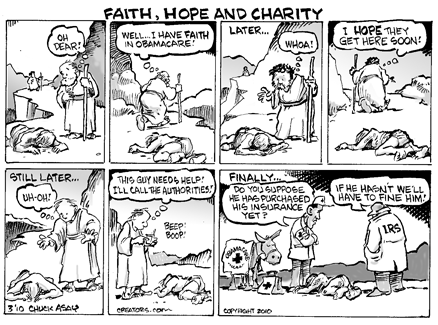
Here comes into play the global pandemic of Samaritans worldwide.

More frequently than ever before, these helpful bystanders are targeted themselves: in the streets of metropolitan cities, some accidents are staged so as to rob or abuse the helpful person. Elsewhere, strangers are looked on with suspicion and so their help is refused. At worse, their help is considered to be a declaration of culpable guilt of having harmed the victim in the first place.
From Chuck Asay

Humanity has grown so introverted and self-centred that it is a difficult time to be charitable just for being charitable.

Regarding the instance in China, within hours of the story breaking, it had trended to the top of Sina Weibo, a Chinese version of Twitter. Commenters argued that “This society is seriously ill. Even cats and dogs shouldn’t be treated so heartlessly,” whilst another poster, named Johnny Yao wrote to establish the defining paradox of our modern lives: “Everyone is praising the rubbish-collecting granny for helping, but isn’t it normal to help someone who is wounded or dying? This just shows how abnormal is the moral situation in this society!”

Questions regarding the place of helpful citizens remain a key priority: in China particularly, there have been recent cases where the Samaritan is wrongly held accountable for various problems. A bus driver that stopped to help a woman on the street was accused of having run her over, and the story went national. The elderly lady had to make a statement in the defence of her rescuer.

More importantly, a man that took a fallen woman to hospital was brought back and made to pay expenses for her treatment, as he could have been a part of her incident. Mr Peng Yu’s decidedly unjust case has become infamous within the country and due to various coined phrases, Chinese citizens now live in the shadow of the sequel of the Peng Yu case.

If we are to continue to blame, abuse and mistreat our do-gooders, our morally valuable citizens, then we promote and champion a system by which we continue to downgrade and attack each other in the hope of material or worldly gain.
The front cover of a Chinese newspaper, featuring the parents of the toddler.

Mounting disrespect, maltreatment and set-up scenarios have left the number of willing citizens dwindling. 

Who could blame them for doing so? Whilst we all hope that someone would come to our own aid in any such terrible situation as being run over, we all know and fleetingly accept that our own decision as a bystander is often to continue with ignorance.

Hypocritical to the last, a growing number of citizens want help, but do not deliver it themselves.

Other cynics condemn those that help to be merely searching for a spotlight. However, maybe there need be a spotlight on those values that have been lost in an age of technological, medical and lifestyle advancement. Otherwise, humanity will be regressing already.

Wednesday, 4 May 2011

Fairer Votes? Just Give Us A Fairer Government!

Elections on the 5th May have generated a great deal of interest as they rightly should. Last year’s national election saw a hung parliament and  a consequent coalition has emerged: that twelve months later it has a united front is evidence of the dedication and commitment each party has made to compensate, compromise and collaborate with each other. Coalitions are indeed often considered weak and ineffective, but this government has so far tackled huge issues (which undoubtedly leave a lot of room for problems and grumbling) concerning education costs and public sector reforms. 

Now the promise of a referendum is delivered. Never in recent centuries has there been such a crucial opportunity to change our system of enfranchisement. As ever, every voter counts. Not only do recent polls demonstrate that opinion is spilt, swinging back and forth on the issues, but with fewer people actively interested in politics at large, this event has created an air of suspense between many. 

65.1% turned out in the elections of 2010 and this was considered a great achievement considering the previous election had only received 61.4% and prior to that 59.4%. However, we should consider that only as far back as 1997, there was a 71.4% turnout – and that was the lowest recorded figure in the post-World War Two era. No doubts can be held that there has been a significant drop in the number of voters – and yet there is greater concern about the way in which our government passes law. In this case, the first method by which to attain a fairer government appears fundamental: vote. With more than a third of the nation not helping to gage true feeling and beliefs, there is not the room for government to be considerate.

Yet, we may question the reasons behind the sudden drop. In a politically correct era, politics has become increasingly filled with jargon and specialist lexicon that prevent access and appreciation for the system. Moreover, with greater media outlets than ever before, parties have simply not campaigned as widely as they possibly could. People’s interests lie in so many different areas today that a government, especially one riddled with cynicism from any onlooker, needs to adapt to circumstance and target groups all through the term – not just at election time. There need be change effected for good, not for votes. Therefore, government need be more clear and defined and pro-active; so make them work for this.

Of course, the previous ideas of making politicians work all throughout their time in parliament sounds quite novel to many sceptics. However, the image serves to highlight how far politics has become a game. We only become actively involved as a society when elections are taking place. Whereas in decades gone by, social reforms, political movements and technological advances ensured politicians were seen every day to make comment and move people to belief, today politicians appear more competitive for votes each April alone and do not add much to their public sphere over the intervening year.

Some of this point scoring politics can be seen quite clearly in the current AV campaigns. For example the ‘No to AV’ programme points out costs that appear quite negligible in the long-term. It suggests millions will be spent on AV in explaining how it works – this should be common knowledge for us to make an informed decision BEFORE voting, not after it could become implemented policy. Also, discrediting the scheme through costs on new machines is hardly an acceptable argument – such machines would be useful under EITHER system of politics. However, more than these, the suggestion that there is excessive cost at having this referendum is rather insulting: democracy should be upheld at all costs; voices should not be ignored because of the ‘price’ of political freedom.

This is not to say that the ‘Yes’ voters have fared much better in their attempts at an independent campaign. It suggests that the AV system provides a bigger say in who comes first and last, and yet this phrase does not reflect the complexity of the vote count. In introducing this vote, there was a pledge it would help tackle what is commonly referred to as ‘seats for life’, but it will leave more than 200 seats unchanged. And surely the every vote counts argument is not unique to AV?

Increasingly, there appears cause for despair. Whilst politicians tackle each other with out of context quotes and front page jibes, the general public are left more unaware of the political ties. Although we have an impression of which party prefers whatever course of action relevant to a particular issue, there is little concrete argument as to why this conclusion has been reached: for both sides refer again and again to similar points.

In short, government is in need of reform and it is only achievable through the collaborative voices of the electorate ourselves. In seeking change, we seek politics to affect our daily lives for the better, for politics in action. No longer should these leaders of nations mock each other’s aims and sit passively by for a large proportion of the year. If only we exercise our own liberties, we could achieve such a more functioning government in many ways. No fully functioning government is given to us on a plate.

For more detailed insights to the flaws of the AV campaign, visit: http://thedolphinsblowhole.wordpress.com/2011/05/03/the-straw-man-referendum-how-the-av-debate-misses-the-point/