Showing posts with label Scotland. Show all posts

Friday, 15 June 2012

The Full Food Picture


If the worldwide events of the last 18 months in particular have taught us anything, it is that social media should no longer be under-estimated as a medium of leverage and influence. From the Egyptian revolution, to the London riots, to the continuing Greek debt crisis, the internet sphere of communication is sure to pioneer social revolutions from here on out.

This idea is evidenced as one youngster’s blog is banned in Scotland, with the effect that the already popular NeverSeconds site has become an overnight sensation and many have rallied behind the posts.

The premise behind the blog is a primary school child taking pictures of her school dinners each lunchtime, uploading them to her blog alongside health ratings, mouthfuls, pricing and other details about the meal.

In the past month, the blog has managed to secure support and interest around the world, young Martha – known online as ‘Veg’ – has been inundated with images of school meals from across the world, with those who forward photos applying the blog’s standards of information about each meal.

Such an easy concept, the blog has not only risen to prominence on the internet, but has caught the attention of important chefs, such as Jamie Oliver.

Yet, the Argyll and Bute council banned the youngster from uploaded pictures of the school food to her blog following a local newspaper article on the site with the headline “Time to fire the dinner ladies”. The council issued a statement in which it explained that since coverage of the blog had raised issues and concern for the jobs of catering staff at the school, a decision had been made to stop photos being taken. In addition it suggested that “The photographic images uploaded appear to only represent a fraction of the choices available to pupils”.

Controversially banning the blog has sparked an internet wide rally to arms to lift the ban on Martha’s blog, which not only worked, but has generated many tens of thousands of pounds for Martha’s chosen charity, Mary’s meals. The amount raised at the time of writing is in excess of £30,000, up from just £2,000 (a mean feat for a primary school child) on Thursday.

Banning the blog appears to have been a rash and ill-considered decision by council officials. Whilst their claim that the subjective opinions of Martha have caused concern and worry to the staff need be considered, the child and her father had previously sought permission to start up the blog, which the school granted. Withdrawing that right only seems to spark concern over the quality of food on offer all the more, as if the catering companies and canteen staff have something to hide (Martha never found any hair in her food at least!).

Over the course of the blog, the quality of the food that Martha has photographed appears to gradually be improving, which suggests that the school were considering the impacts of the site and changing their services for the better – a move to be commended if anything.

Moreover, it appears to me that the council have failed to capitalise on a unique opportunity of cultural exchange. The blog, receiving international hits and interest from youth to adults alike, could have promised to be the hub of a revolutionary scheme for school meal exchanges. With interesting dishes from Taiwan to Finland uploaded, schools nationwide could have used the blog as a sharing centre to encourage children to try and sample foods from across the globe, teaching about different cultures, healthy food choices and why diets differ to accommodate lifestyles worldwide. In addition, Martha’s blog could have been used as a social tool, allowing users and researchers the opportunity to investigate foodstuffs available to different parts of the world.

A Mary's Meals spokesman said: "We are overwhelmed by the huge response to her efforts today which has led to so many more people donating to her online donation page.

"Thanks to this fantastic support, Martha has now raised enough money to build a kitchen in Malawi for children receiving Mary's Meals as part of our Sponsor A School initiative and has broken the record for hitting a Sponsor A School online fundraising target in the quickest amount of time".

Freedom of opinion and speech needs to be extended to the internet, and it strikes me that this was a grave infringement on the very purpose of the expressionist mode of the blog. Fortunately, in this case, the block backfired and promoted further visits to the site in question; but should the internet become a zone of censorship, there could be grave implications for freedom of expression.

In this case, the collective communities of blogs, Twitter, Facebook and social medias used the arsenal at their disposal to repeal the ban and this is testament to the way in which these domains are becoming more integrated into society not only as a record of our lives, but a historical record of our times, our generation and the momentous occasions to which we bear witness. 


Saturday, 28 January 2012

Track Two... A Departure to 2026.

Confirmation that the HS2 rail link between London and Birmingham would go ahead earlier this month was met with little applause.

Many people have slammed the government project due to the routes cutting through “areas of outstanding national beauty” and the plans had to be adjusted last minute in a ditch effort to get the plans past parliament.

Indeed, the majority of disgruntled peoples who object to the scheme fall under that umbrella acronym of NIMBYs (Not In My Back Yard), being persons who would normally encourage the development of such a (rail) infrastructure and yet refuse to show support as it may disrupt their lives ever so slightly.

My issue is to the contrary. The HS2 link does not go far enough.

Rail travel within Britain, where the mode was first pioneered, has become slow and unreliable. The passengers who depend on the rail links are subject to overcrowded carriages, infrequent trains and expensive costs. Most of the UK system still runs on lines that were introduced in the late Victorian era, and this is not suitable for a 21st century country.

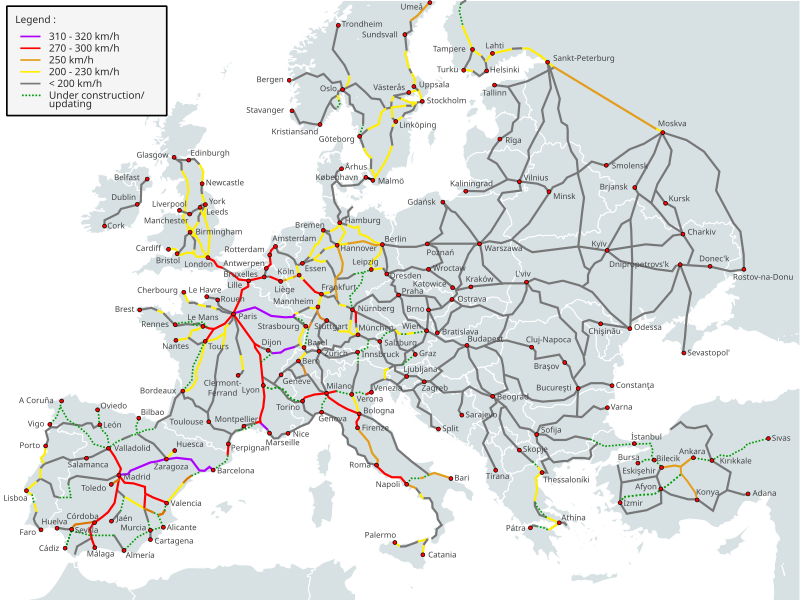
High speed rail has been expanding across the EU since the 1980s and has had significant investment in France, Germany and Spain, amongst others. Routes available on high speed service across mainland Western Europe is unrivalled on this continent; yet even within Germany before full roll-out, there are plans and schemes for Maglev-esque vehicles, increasing speed, efficiency and lowering costs by reducing friction.
Europe Railways in 2011, highlighting major high-speed investment in France, Spain and Germany.

Yet Britain appears completely unconcerned with the benefits that a modern rail system provides.

The small scale expansion into High Speed rail was introduced by the channel tunnel as recently as 2007 – seemingly forced by Europe as trains on the French side of the channel were capable of performing at speeds almost double the London-Folkestone average. For no real reason other than lack of investment.
Promise of the first major expansion to Birmingham is not to be operational until 2026. Any further links, preliminarily to Manchester and Leeds, will not open until 2034 at the earliest. The chances of this type of rail reaching Scotland before the 2040s? Remote to non-existent. There is a real lax approach as to the implementation of the scheme as a whole.

It is confounding how a line that promises a 50 minute reduction between London and Manchester and an hour reduction between London and Leeds is not being capitalised upon sooner.

Already, the Birmingham link alone is projected to generate some £43.7billion of wider economic benefits and generate £27billion in rail fares on these lines alone. Not to mention that the need for a wide spread introduction of the links, in every aspect from administration, to HR, to contracting, could create countless jobs at a time of severe economic crisis.

Longterm, the service would offer job migration. A person living in Manchester could work in London. A person living in Glasgow could work in Manchester. It opens up an entirely new field of connections and job prospects in areas of the country that were once reserved for those within a certain radius. Let’s face it, if Scotland becomes independent, Edinburgh will need a high speed link to London and from there to Europe. Current travel time between London and Edinburgh sits at an unappealing 4.5-5hours. With HS2, that could become 2.5 hours.

Moreover, the lack of enthusiasm for quick installation is unnerving. Firstly, the current proposals do not integrate the line into the National Rail system completely, having the Birmingham terminus exist in its own self-contained unit instead of arriving into Birmingham New Street, the central transit hub of the West Midland city.

Further, as previously mentioned, other European countries are already abandoning this train of thought in favour of other more advantageous railway systems: notably, the greener, more efficient and more cost effective Mag-lev, which is becoming the norm in Japan and a sensation in China.

Where might this innovative infrastructure have been tested then I hear you ask? None other than Birmingham, UK.

By the time the High Speed Line in its current incarnation is implemented to anywhere near the capacity required of the British public, it will already be defunct and an obsolete antique before introduction. The entire system need be bypassed in favour of more cutting edge and innovative means of transport.

If sufficient hands were contracted, lines connecting London to Glasgow, via Birmingham and Manchester, and London to Edinburgh, via York and Newcastle are not out of the question before 2025-2030. Yet the government is unwilling to invest in its own country, whilst the British railway, jewel of Victorian invention, is set to innovate countless people’s lives across the world before the decade is out.

With many lines already operating at over 80% of capacity at morning peak, High Speed is the only way to ensure the country keeps moving.

Thursday, 26 January 2012

Flower of Scotland


1916: In the middle of World War One, Ireland stages a bid for independence in Dublin, threatening the British chances of success at a crucial moment in the war effort.

2012: In the middle of the worst recession since the Wall Street Crash, Scotland stages a democratic bid for independence “in Edinburgh, in London, or anywhere the Prime Minister pleases”, with many deeming the act detrimental to British growth at a crucial moment of European downgrading.

Certainly, the debate waging around the possibility of independence versus unity has seen battle lines drawn, but these may be premature concerns.

Previous breakups of the United Kingdom in Ireland provide a primary cause for concern. However, the eventual independence granted to Ireland was more an appeasement following a costly war, with transition handled distastefully by both parties. Looking back over the course and administration of the change of power, there are easily identifiable mistakes that could (and should) be avoided in the case of Scottish independence.

Continued violence and hostility is the true legacy of Irish independence and that was a threat suffered particularly till the turn of the century, but a decade ago. Scottish independence, on the other hand, would be entered into through democratic debate rather than the forceful mode of conduct that kickstarted and marked the Irish movement. England, not as prominent on a world scene, would be more amenable to these discussions than its own rash nature almost 100 years ago, when maintaining status was a priority.

Besides, a peaceful resolution would be encouraged while resources are stretched so thin across the United Kingdom due to cuts.

However, Scotland would surely earn the lion’s share of these resources from a split. Economically vibrant at the moment, Scotland has, as expected, the second largest GVA per capita in the United Kingdom, after England. Yet, many do not appreciate, or are completely unaware of, the fact that revenue from the North Sea oil rigs are not included in these figures, as the profit is currently ‘distributed’ around the UK instantly. With independence, 91% of the oil area lies within the Scottish borders. The sudden wealth that would be available to the northern territory as a whole would transform many areas of public spending and investment: leaving Scotland with little deficit.

In fact, it is already recognised that Scotland is the largest producer of petroleum within the EU, and that there is potential for other offshore oil-sites.

Additionally, Scotland is the central zeitgeist for whiskey lovers worldwide. Exports in specialisms such as whiskey, shortbreads, fudges and fishing produce earn the Scottish country a reputation for delicacies renowned the world over. Add the prominence in manufacturing and construction (Glasgow for example houses the largest shipping construction area within the UK), and one can see the advantages to a booming Scottish economy.

Already a relatively rich nation, the boost proffered from continued exports would ensure gained capital and circulation of the pound. In 2007 alone, Scotland’s top 10 export destinations alone earned the country in excess of £18,825 million. Imagine the growth in this figure with Scottish independence, backed peacefully by England.

In turn, this could help Scotland to tackle its slums and poverty problems. Despite the economic benefits of the oil, there is still marked difference between lifestyles of many Scots and their counterparts south of the border. An average male in Glasgow for example only has a life expectancy of 69. Scottish public services see themselves as inhabiting a different social area than England and Wales, with different key issues of poverty, drugs, and unemployment to tackle.

However, even with the separation, use of the GBP will insure continued intrinsic links with the remaining UK factions. Extra trade on the pound from Scotland will ensure continued circulation that benefits England and Wales itself in the long run.

A poll by YouGov last May showed marginal support for the move, but an overwhelming rejection from Scotland itself.

Perhaps the break-away of Scotland would also encourage a deeper look at the British image: a modern twenty-first century conglomerate of cultures hinged on London. The investment seen across Scotland should be mimicked across larger areas of the UK. HS2 makes some steps in that direction, but relatively few and relatively slowly. England is not capitalising upon its current market opportunities. Expanse of infrastructure would allow greater migration of peoples across the country for jobs. Focussing our main sources of income on development would allow a certain independence in a time of Eurozone uncertainty, creating a more stable market area.  A galvanised population to the North could teach English people a thing or two about national pride for sure.

Scuppering Salmond’s hopes for Scotland however are the Welsh and Irish members of Parliament, claiming that Scottish dominion in its own right would leave the two areas outvoiced within Westminster.

Nonetheless, considering moves towards Welsh parliaments, it would appear rather foolhardy to prevent progress for the sake of tradition. Not only does the move allow England a greater democratic voice, but it is not in the apocalyptic fashion that the Welsh and Irish describe: rather radicalisation on both sides of the border due to the split would see new ideas emerge as to how the country should be run and here lies the prospect of wide social and cultural change (the thing the Welsh and Irish appear to advocate amidst a Tory government).

With no date currently set for the vote (despite furious debate over timing this past week), we shall have to watch the development and resolution of lingering issues, such as currency, military, and Nuclear warheads over the coming months.

Shaking of the shackles of union is never an easy transition, but for the cultural, economic and social benefits that Scotland could wager, perhaps the UK should be more amenable to the shouts of “FREEDOM”.